
When uncertainty becomes the new normal, the real measure of leadership is not the plan an organisation writes but the decisions it makes when that plan is finally tested. In a connected world where geopolitical tension, operational disruption, and fast-moving risk can reshape a business overnight, resilience has stopped being a contingency and become a defining capability.
For Divakar Pandian, Founder and CEO of Resilience Next, building resilience means preparing an organisation for the events it hopes never to face but must always be ready for. Through years of business continuity and crisis work, he has watched closely how organisations behave under real pressure: what separates the ones that hold together from the ones that freeze, and why effective crisis management reaches far beyond documents and software.
In this exclusive feature for The Global Icon, Divakar draws on recent experience across the Middle East to discuss leadership under pressure, operational readiness, employee wellbeing, supply chain resilience, and the honest role of technology when everything is moving at once.
Where Resilience Meets Reality
A business continuity plan is meant to be the organisation’s blueprint for uncertainty. Recent events across the region reminded Divakar of something quite different. “When a crisis actually hits,” he says, “nobody opens the document first. People fall back on their behaviours, their relationships, and the decisions they already know how to make. The plan comes later, as a reference.”
For him, the opening moments of any crisis are the honest test of whether resilience was built into an organisation or merely written down. And in his experience, the two are rarely the same thing.
The Critical First Hour
There is an uncomfortable truth Divakar returns to first. Most of the organisations he came across, the ones that were mandated and regulated, had a plan that was approved, implemented, and properly audited against the standards and regulations they were required to follow. And almost every one of those plans, somewhere in its scope, had quietly declared that an act of war was out of scope.
“So the very first thing that had to change was not the company,” he explains. “It was the standards and the regulations themselves. The event everyone had formally excluded was suddenly the event in front of them.” Organisations with audited, approved, implemented plans still had to jump straight into crisis management, only to find the plan offered little for the situation they were actually in.
That is why so little of the first hour follows the script. What carries the response instead is behaviour: an out-of-date phone tree, a WhatsApp group that has quietly become the real command channel, and one question that surfaces in almost every organisation, which is simply who is allowed to say yes. Divakar recalls one chief executive who learned that his own regional office had already evacuated from a forwarded WhatsApp message, not from his crisis team. On paper the notification cascade had four tiers. In reality it had one, and it was informal.
The deeper flaw, he argues, is in how plans are built, department by department, or around a tidy list of scenarios. Very few are stress-tested for high-consequence, wide-scale unavailability. “What do you do,” he asks, “when your suppliers are entitled to declare force majeure and simply stop, and you are an entity that is not allowed to? Where is the extraordinary contingency for exactly that situation?” For most, it was never written, because it had been ruled out of scope years earlier.
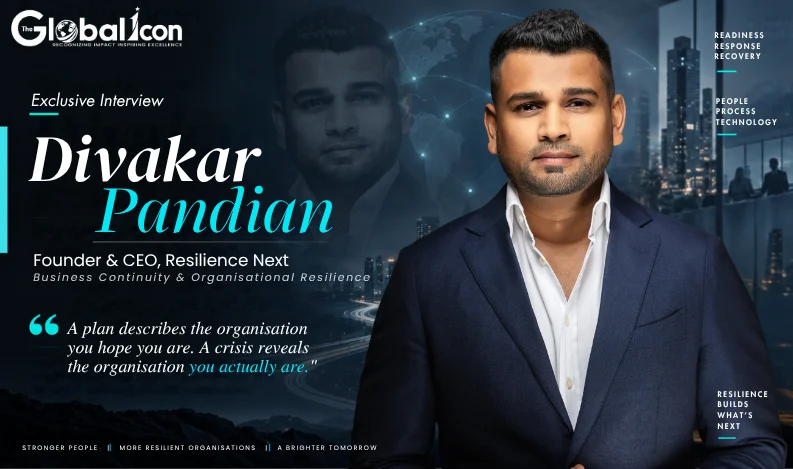
A plan describes the organisation you hope you are. A crisis reveals the organisation you actually are.
Why Rehearsal Beats the Perfect Business Continuity Plan

The factor that separated the steady from the shaken, Divakar is clear, was never the polish of the document or the size of the crisis team. It was a rehearsal. “The organisations that stayed operational had practised until crisis response felt familiar rather than exceptional,” he says. Many had drilled scenario-agnostic approaches, supported by tooling that could tell them, at any moment, what was critical at the level of people, technology, suppliers, and information, tested over cycle after cycle until it lived in the culture. “When the real event came, most of them didn’t even need a formal invocation. They just knew, broadly, what to do, and they adopted it.”
What struck him most was a shift in mindset among the strongest performers. Amid all the pessimism and grey areas, some organisations decided very quickly that this was their moment to catch up with, and even overtake, their competition. If they could keep serving customers through a period like this, they would build a lead and a reputation rivals might not close for years. That was especially true, he notes, in places living under the threat of conflict rather than open conflict, where companies keep operating while carrying the quiet anxiety that an evacuation, or emergency housing for staff, could be needed at any moment. E-commerce, delivery, hospitals, banks, tourism, and utilities, the ones that had rehearsed, kept ramping up while others stalled.
Two further things set them apart. The first is clearly established decision rights, settled in advance, so nobody loses the opening day debating who may suspend travel, authorise emergency spending, or speak publicly. The second is financial resilience. The organisations that rehearsed also tended to forecast better, and many carried up to two years of runway for a rainy day, a buffer that let them feel safer and pivot to alternative technologies, suppliers, and markets they had never before needed to explore.
Employee Safety and Mental Health in a Crisis
This is the part Divakar cares about most, because a plan quietly assumes people will be available when systems fail. When the threat is generational, a conflict on the home ground of operations, something most of the workforce has never lived through, that assumption breaks. “How do you ask someone to step away from their family,” he asks, “to support the recovery of a company? Many of your most critical people are frightened for exactly the same reasons as everyone else.”
And yet he saw something moving. In certain sectors, hospitality above all, trained service staff helped evacuate others, sometimes while needing to evacuate themselves. People genuinely wanted to contribute, with no expectation of reward. “The mistake,” he says, “is to lean on that goodwill without protecting it, to expect a normal week from people living through an abnormal one, and to read someone going quiet as underperformance rather than distress.”
The leaders who handled it well did the human things properly. They recognised that their resilience champions were themselves people carrying personal fear, so they built in rotation and identified timely backups, so no one shouldered it alone. They debriefed. They offered guidance, and they acknowledged their contribution out loud.
One example has stayed with him. Some organisations gave extra leave, a dedicated leave basket, for those who stepped up during the crisis. One took the families of its responders to a theme park, a full family day out, so that a husband, wife, son, or daughter could feel proud of what their person had done for the company, whatever their rank. For Divakar, that is what treating people as a critical dependency actually looks like, not a clause in a plan, but a day out with the family.
People are a critical dependency, exactly like power or connectivity. You cannot be resilient while your workforce is frightened, exhausted, and uninformed.
Supply Chain Risk in the Middle East: Hidden Dependencies
A colleague once described a crisis to Divakar as a fountain of challenges: unprioritised, unstructured problems thrown at your face all at once, forcing you to choose between them in real time. That, he says, is exactly how the recent disruption felt. Airspace closures, rerouted shipping, and repriced insurance did not queue politely; they landed together, and every choice became a live calculation of risk against reward, how much more is lost by acting, how much more by waiting.
What it exposed was that most companies understand their suppliers but not their dependencies. “Nearly everyone could name their tier-one vendors,” he says. “Very few knew that four supposedly diverse suppliers routed through a single corridor, or that a critical part came from a tier-three manufacturer no one had ever assessed.” Alternatives that looked independent on a spreadsheet turned out to share an airspace, a port, an insurer, or a jurisdiction, and when those closed or repriced, the alternatives failed together.
His other lesson is one of endurance. “It is a marathon, not a sprint.” A crisis like this creates a sense that it will soon pass, and it does eventually reach an endpoint, but it can drag on far longer than anyone can hold full emergency intensity. The organisations that coped treated it accordingly. They rerouted crisis work into an everyday rhythm, short daily stand-ups run more like an athletic team than a bureaucratic reporting chain, closely supported by advisers and subject-matter experts on demand, and by software that held a single source of truth so everyone worked from the same picture. The real question, he says, was never only who do we buy from. It was what has to stay true in the world for this to keep flowing.
The organisations that fared best had gone further still, down to what Divakar calls the foundational, resource level. They had run their business impact analysis not just across processes but across the seven building blocks every process quietly depends on, people, premises, technology, suppliers, vital records, equipment, and external stakeholders, and for the critical ones they had built recovery strategies and recovery plans tailored to each. “That matters,” he says, “because when an impact lands, it is rarely uniform. Adverse weather or a geopolitical threat might not touch every department, or even every critical process. It might hit one single resource, one supplier, one piece of equipment, one external stakeholder, one set of vital records. If you have a plan at that level, you have an assurance of recovery whatever the scenario turns out to be.”
The catch is effort. Planning to that depth by hand, resource by resource, is close to impossible, and this is where Divakar sees the honest case for technology begins.
Technology Is an Enabler, Not the Leader

Divakar is careful to separate technology’s genuine value from the promises made on its behalf, and he starts with the limits. “A dashboard nobody has opened in ten months is worse than useless, because it creates a feeling of readiness without the substance.”
There is a deeper trap, too. Organisations tend to hand crisis management to the crisis team, the business continuity managers and risk champions, and expect them to own the decisions. “That never really works,” he says, “because those are the experts who set up the programme. They cannot own decisions that were never theirs to make. Ownership has to sit with the business.” In his experience, that transfer of ownership rarely happens without business continuity software, because in practice software is what puts a decision in front of the right person: a licence in their name, a reminder of the call they need to make, a request for sign-off, a notification on their phone, the mass notification that has to go out, the regulatory report that has to be filed.
Where technology truly earns its place is in removing that friction, and in scale. “When you are managing parallel crises at once, you cannot clone your best people,” he says. What good tooling can do is carry the load beneath them: keeping the contact list true so an urgent message reaches thousands in minutes, making rehearsal cheap enough to run monthly, mapping dependencies before a corridor closes, and giving leadership a real-time, board-level view so extraordinary requests escalate to executives instantly from the operations teams on their phones. Handled well, he says, that has protected businesses and protected reputations.
It is also, he argues, the only realistic way to keep pace with threats as they emerge. The ERM Next AI capability continuously scans the horizon, maps what it sees to an organisation’s risk registers, and tells leaders, in real time, how exposed they are at that exact moment. “That used to take risk teams weeks or months,” he says. “Evaluating it live, predicting the likely impacts and consequences of a threat as it develops, is simply not possible without AI.”
That prediction is only useful if it drives a response, and this is where the modules connect. What ERM Next predicts flows into Crisis Next, where incident, emergency, and crisis management run through a live Situation Room, and from there into BCM Next, which activates the business continuity plans, recovery capabilities, and resource-level recovery goals prepared in advance. “The standards tend to set recovery objectives at the process level,” he says. “We prepare them at the resource level, and preparing to that depth is simply not humanly possible without AI doing the heavy lifting.”
And when the impact does arrive, that same foundation carries the response. With the BCM Next AI capability, Divakar says, clients were able to activate their continuity plans in real time, notify their people mid-crisis, monitor what was happening, and evaluate recovery progress as it unfolded. “None of that is feasible at speed without today’s technology,” he says. “You cannot manually stand up that picture while the crisis is still moving.”
There is an upside people forget, too. Resilience Next has helped clients earn genuine recognition for how they handled a crisis, to be able to say that a given organisation showed real strength and became a benchmark for its peers and its sector. “That,” says Divakar, “is where software stops being a tool and starts building the ethos of an organisation.”
Technology does not replace judgement. It removes the friction that stops judgement being exercised in time. In the worst moments, that makes it a friend you are very glad to have.
Key Takeaways
- Plans give guidance, but behaviour, not documentation, decides the quality of the first response.
- Standards that rule major threats out of scope leave audited, approved plans exposed when those threats arrive.
- Rehearsal builds the confidence and consistency that let organisations adopt a response without waiting for a formal invocation.
- Decision rights settled in advance remove the costliest delay in a crisis: the argument over who decides.
- Employee wellbeing is a critical operational dependency, and the strongest leaders protect and recognise the people who step up.
- Real supply chain resilience comes from understanding hidden, shared dependencies, not from a list of suppliers.
- The deepest preparation runs to the resource level, people, premises, technology, suppliers, vital records, equipment, and external stakeholders, because an impact often strikes a single resource rather than a whole department.
- Technology earns its place by removing friction, enabling scale, and transferring ownership of decisions to the business, never by replacing judgement.
A Final Word
As organisations navigate a more complex and unpredictable world, resilience can no longer be something that exists only during an emergency. It is built in advance through preparation, reinforced by leadership, and strengthened by the everyday decisions that shape how people, processes, and technology come together when the pressure arrives. Divakar Pandian’s account is a reminder that effective business continuity is less about responding perfectly to every crisis and more about building an organisation that can adapt with confidence when the circumstances change, and, more often than people expect, emerge from the experience stronger than it went in.
Divakar Pandian is Founder and CEO of Resilience Next, an enterprise resilience platform used by organisations across more than 90 countries.
Explore the platform at resiliencenext.ai, or try the free public tools at bcmtool.com, ermnext.ai, and crisisnext.ai.
- Instagram - divsnap
- Facebook - Divakar Pandian
More Cover Stories:-