
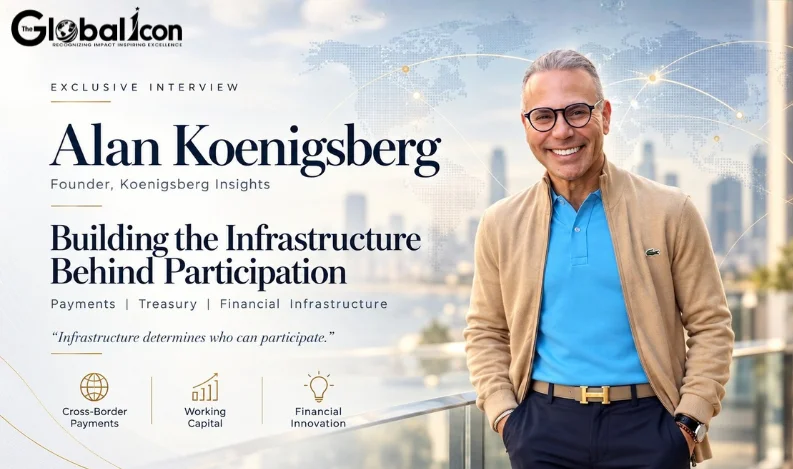
In Conversation with Alan Koenigsberg
Interview by: Matt Lee
Edited by: Pankaj Sati
TheGlobalIcon recently sat down with Alan Koenigsberg for a wide-ranging conversation about financial infrastructure, payments, artificial intelligence, institutional knowledge, participation, storytelling, and what it means to pay experience forward.
With more than three decades across global financial services, including senior leadership roles at American Express, J.P. Morgan, Bank of America Merrill Lynch, and Visa, alongside fintech, Koenigsberg Insights, nonprofit involvement, mentorship, philanthropy, and film production, his journey crosses worlds that may initially appear far apart. For Koenigsberg, however, they are congruent pieces of a larger mosaic, connected by participation, acceptance, judgment, and building infrastructure that creates opportunities for everyone rather than a select few.
As financial systems evolve, AI reshapes decision-making, and generations begin transferring knowledge and responsibility, we spoke with Koenigsberg about what connects these different dimensions of his work and what he believes should come next.
Here are the key insights from our conversation.
Infrastructure That Enables Participation
TheGlobalIcon: You have spent more than 30 years in financial services. When you look back, what is the common thread?
Alan Koenigsberg: Infrastructure.
That sounds technical, but I don’t think infrastructure is technical at all. Infrastructure determines who can participate. If a business can’t move money efficiently, can’t get access to working capital, can’t transact across borders, or can’t trust the system, that has a real economic consequence.
I’ve had the benefit of seeing this business from a lot of different angles: operations, credit, product, corporate banking, treasury, payments, technology, and commercial leadership. That breadth shaped how I think.
I learned early that you cannot really understand payments by looking only at the payment. You have to understand what happens before it, what happens after it, who assumes the risk, and why somebody is moving the money in the first place.
Lessons at Global Scale
TheGlobalIcon: Your career includes American Express, J.P. Morgan, Bank of America Merrill Lynch, Visa, and fintech. What did moving across different institutions teach you?
Alan Koenigsberg: That no institution has a monopoly on good ideas.
Each organization taught me something different. I spent time close to operations and credit, which gave me enormous respect for the machinery underneath a financial institution. At J.P. Morgan and Bank of America Merrill Lynch, I saw the world through corporate banking, treasury, and the needs of large multinational clients. At Visa, I had the opportunity to look at payments at a truly global scale.
My experience eventually included senior responsibility for treasury, working-capital, and commercial-payment solutions, as well as leading the commercialization of Visa B2B Connect, Visa’s multilateral cross-border B2B payments network. Before Visa, I served as Chief Revenue Officer at German payments and supply-chain fintech Traxpay and as a Managing Director and Corporate Banking Group Executive at Bank of America Merrill Lynch.
Fintech gives you a completely different education because suddenly resources aren’t infinite. You have to decide what matters, move quickly, and prove that somebody is actually willing to buy what you’re building.
The combination is important. Strategy without execution is just a presentation.
The Power of Independent Judgment
TheGlobalIcon: After decades within major financial institutions, what led you to create Koenigsberg Insights?
Alan Koenigsberg: Independence.
When you’ve spent decades inside large institutions, you accumulate experience, but hopefully you also accumulate judgment. I wanted the freedom to use that judgment without having to begin with a particular product or institutional answer.
A client doesn’t necessarily need another 100-page strategy deck. Sometimes they need someone willing to say: This is the real problem. These are the three things that matter. This is what I would stop doing. And this is where I would put the money.
That’s the space Koenigsberg Insights occupies.
The work spans financial institutions, fintechs, corporations, and executives confronting the next transformation of money, with a focus on payments, treasury management, corporate and transaction banking, working capital, financial technology, and financial infrastructure, alongside C-suite advisory and expert-witness work.
For me, it isn’t about moving from a large corporate role into a conventional consulting chapter. It is about applying decades of experience and judgment independently while remaining engaged with how these systems continue to evolve.
Rethinking Payments
TheGlobalIcon: You often describe payments as infrastructure. What does that mean to you?
Alan Koenigsberg: Payments used to be treated as something that happened in the background. That world is disappearing.
Payments now touch national competitiveness, financial participation, cybersecurity, identity, data, liquidity, artificial intelligence, and even geopolitics.
Look at instant payments. Look at stablecoins. Look at tokenization. Look at what central banks are doing. Look at the convergence of payments and working capital.
These aren’t isolated products anymore. They’re becoming components of a new financial infrastructure stack.
And infrastructure determines participation. Participation determines prosperity.
That perspective has increasingly brought me into conversations with central banks, payment infrastructures, and industry leaders internationally. Most recently, I moderated a cross-border payments panel at the 2026 Central Bank Payments Conference in Istanbul, following other engagements covering central banking, emerging markets, and payments modernization.
Beyond the Trend List
TheGlobalIcon: You have also become increasingly visible as a writer, commentator, and conference moderator. What are you trying to bring to those conversations?
Alan Koenigsberg: I think our industry has plenty of information and not always enough perspective.
Everybody can repeat the trend list: AI, stablecoins, real-time payments, tokenization, embedded finance. The harder question is: So what?
What changes because of it? What breaks? Who benefits? What happens to economics? What happens to risk?
That’s the conversation I’m interested in.
My writing has covered BNPL, instant payments, central-bank infrastructure, financial participation, stablecoins, and cross-border payments. More recently, I’ve been thinking about a less obvious risk: the simultaneous transfer of wealth, institutional knowledge, and decision-making authority to a generation increasingly supported by AI.
Alongside that work, I sit on the Editorial Board of Trade Treasury Payments and previously served on Cardlay’s Advisory Board.
The Bridge Generation
TheGlobalIcon: Why have institutional memory and AI become such important subjects for you?
Alan Koenigsberg: Because we’re talking endlessly about artificial intelligence and not enough about the intelligence we’re allowing to walk out the door.
My generation straddled two worlds. We remember the analog world, and we participated in building the digital one.
We went from paper and mainframes to PCs, the internet, smartphones, real-time payments, and now generative AI. That’s an extraordinary period of change.
The danger isn’t AI. The danger is assuming that because technology can produce an answer, it understands why generations of practitioners learned to ask a particular question.
There is a tremendous amount of institutional judgment that was never written down. We have a responsibility to transfer it.
That is also where paying it forward becomes important to me. I see it as a currency for the future, with Gen X occupying a unique position as a bridge generation. Transferring experience and institutional judgment isn’t about preserving the past. It is about creating stronger foundations from which the next generation can build, improve, and eventually lead.
Beyond the Numbers

TheGlobalIcon: Banking and Hollywood are not an obvious combination. How did film become part of your story?
Alan Koenigsberg: They’re actually more connected than people think.
Banking taught me that numbers never exist without people behind them. Film strips away the numbers and starts with the people.
I have always been interested in storytelling, identity, and what happens when people don’t quite fit into the boxes society builds for them.
Producing From Zero to I Love You gave me an opportunity to participate in telling one of those stories. Written and directed by Doug Spearman, the film dealt with identity, relationships, expectations, and the choices people make when the life they’re living and the life they want aren’t necessarily the same thing.
For me, filmmaking is another expression of a broader interest in participation, acceptance, and the human experiences that exist beneath systems and structures.
Changing Minds Through Storytelling
TheGlobalIcon: That work has continued through Milton Ventures Media. What connects your media work with everything else you do?
Alan Koenigsberg: I don’t see the media as disconnected from the rest of my work.
The medium changes, but the question doesn’t: What is the human story?
Milton Ventures Media is about bringing analytical discipline to compelling stories, whether that’s film, documentaries, podcasts, or other media.
I love financial infrastructure. But nobody sits down on a Friday night and says, “I’d really like to watch a two-hour film about payment rails.”
They care about people.
The challenge is learning how to communicate complex ideas through people and stories without losing the substance.
One project I’m particularly excited and proud about is Boorman and the Devil, directed by documentarian David Kittredge. The documentary chronicles the making and legacy of the sequel to the famed horror film The Exorcist. Released in June 1977, the sequel became known as one of the biggest failures in cinematic history.
But this documentary takes another look at that established perception through the story of John Boorman, examining the film’s impact and its lasting effects.
I see it fundamentally as a redemption story for Boorman. It asks audiences and the industry to reconsider the film, its contributions, and the assumptions that have surrounded it. You may be surprised by the outcome. It has changed minds and encouraged another look at the film and what it contributed.
The documentary was accepted into the Venice Film Festival in Italy in late 2025 and entered active distribution. It reached more than 88 theatres and was released for purchase and rental in late September.
David’s talent is extraordinary, and I’m very proud of the documentary.
Purpose Beyond the Title
TheGlobalIcon: There also seems to be a human dimension connecting your nonprofit work with the rest of your journey. How do you see that relationship?
Alan Koenigsberg: Absolutely.
You reach a point in a career where success has to become about more than the next title.
My involvement with the Ackerman Institute for the Family has been particularly meaningful because family systems, mental wellness, education, participation, acceptance, and understanding affect everything else we do.
Board service shouldn’t be decorative. You should bring something useful to the table.
Eventually, you have to ask yourself a pretty simple question: What are you leaving stronger than you found it?
That question extends beyond nonprofit work for me. Business, mentorship, philanthropy, media, and film aren’t isolated pursuits. I see them as congruent pieces of a larger mosaic centered on participation, acceptance, paying it forward, and building infrastructure that creates opportunities for everyone, not just a select few.
A Practitioner at Heart
TheGlobalIcon: You have worked across banking, payments, fintech, advisory, publishing, nonprofit leadership, and film. How do you define yourself today?
Alan Koenigsberg: Probably all of those things, and none of them exclusively.
I’m a practitioner first.
I’m interested in how systems work, why they stop working, and what happens next.
Whether you’re looking at a global payment network, a company, a nonprofit organization, or a film, you’re ultimately dealing with systems made up of human beings.
Technology changes extraordinarily quickly.
Human behavior doesn’t always move at the same speed.
Understanding both is where things get interesting.
When Speed Outruns Judgment
TheGlobalIcon: Looking ahead, what concerns you most about the next five years?
Alan Koenigsberg: Speed without judgment.
We’re making intelligence cheaper. We’re making money move faster. We’re automating decisions. We’re removing friction.
Those things can be incredibly positive.
But not all friction is bad. Sometimes friction is a control. Sometimes it’s the moment somebody asks, “Are we sure?”
The challenge isn’t whether we can move faster.
We can.
The question is whether we’re getting better at knowing where we’re going.
A Currency for the Future
TheGlobalIcon: With so much changing, what makes you optimistic about what comes next?
Alan Koenigsberg: We’ve never had better tools.
We can connect people who were excluded from financial systems. We can move money internationally more efficiently. We can make working capital more accessible. We can detect fraud differently. We can use AI to augment extraordinary human capability.
That’s enormously exciting.
But my generation has a particular responsibility. We participated in building a lot of this infrastructure. Now we have to transfer our experience, judgment, and institutional memory so the next generation can improve it, and then know when to get out of their way and allow them to lead.
That’s what paying it forward means to me.
It isn’t simply passing along knowledge. It is treating experience as a currency for the future and building infrastructure that enables broader participation, acceptance, and opportunity.
Key Takeaways from the Conversation
Alan Koenigsberg’s perspective connects financial infrastructure, technology, leadership, mentorship, philanthropy, and storytelling through several recurring ideas:
Infrastructure determines participation. The systems behind payments, working capital, and commerce influence who can participate meaningfully in economic opportunity.
Judgment matters alongside innovation. Faster payments, AI, automation, and reduced friction can create enormous possibilities, but speed alone cannot determine direction.
Gen X has a role as a bridge generation. Having experienced both analog and digital worlds, Koenigsberg believes his generation carries institutional knowledge that should be transferred rather than allowed to disappear.
Paying it forward is a currency for the future. Experience becomes more valuable when it creates stronger foundations for the people who follow.
Storytelling can change minds. Whether through business communication, film,
documentaries, or other media, Koenigsberg sees human stories as a way to challenge assumptions, deepen acceptance, and encourage reconsideration.
Different worlds can share the same purpose. Banking, payments, mentorship, philanthropy, nonprofit involvement, and filmmaking may operate through different mediums, but for Koenigsberg they are congruent pieces of a larger mosaic centered on participation, acceptance, and building opportunities beyond a select few.
More Cover Stories:-