
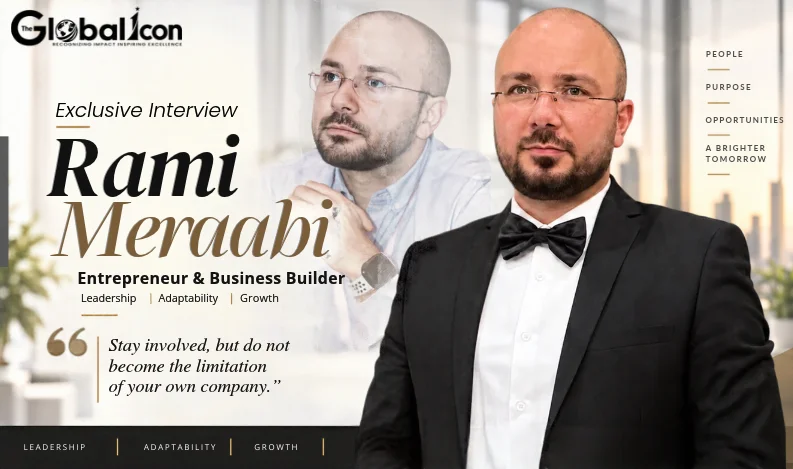
Some entrepreneurial journeys are defined by mastering one industry. Others are shaped by the ability to enter new environments, recognize opportunities, adapt quickly, and build something from the ground up. Rami Meraabi’s journey belongs to the latter.
His professional path began in technology, spanning professional AV, LED displays, smart systems, and system integration, where he worked with international manufacturers, partners, integrators, and customers across the Middle East. Over time, his entrepreneurial interests expanded beyond technology into e-commerce, hospitality, trading, and other ventures, each bringing a different set of challenges and a different way of thinking.
Working between Lebanon and the Gulf has also played an important role in shaping his perspective. The Gulf exposed him to scale, speed, international competition, and ambitious projects. Lebanon, meanwhile, taught him resilience and adaptability,qualities that become particularly valuable when circumstances do not go according to plan.
It is a combination that has shaped the way he approaches business: stay close to the operation, understand the numbers, build strong relationships, empower capable people, and make decisions even when conditions are far from perfect.
In this conversation with The Global Icon, Rami reflects on building businesses across industries, the leadership lessons that came with growth, the changing relationship between technology and business, and his ambition to build companies that can ultimately grow beyond their founder.
Building Opportunities Across Industries
Rami’s professional journey was never built around one company or even one industry. It was shaped by constantly entering new environments, learning quickly, and finding ways to turn opportunities into something tangible.
Technology was where much of that journey began. His work across professional AV, LED displays, smart systems, and system integration brought him into close contact with international manufacturers, partners, integrators, and customers across the Middle East.
But entrepreneurship gradually took him beyond technology.
E-commerce, hospitality, trading, and other ventures introduced different business models, different customers, and different challenges. Each required him to adapt rather than rely on what had worked before.
The contrast between Lebanon and the Gulf reinforced that mindset.
The Gulf offered exposure to scale, speed, international competition, and ambitious projects. Lebanon offered a different lesson: resilience.
Rami sometimes puts that lesson simply: in Lebanon, having a Plan B is not enough,you usually need a Plan C as well.
Behind the humor is an approach that has become central to his way of working. Conditions will not always be perfect, and waiting for them to become perfect can mean waiting indefinitely. The ability to make a decision, adapt when necessary, and continue moving becomes part of the job.
Today,Rami describes himself less by an industry and more by what he enjoys doing: building businesses, connecting opportunities, and turning ideas into operating companies.
Leadership Without Becoming the Limitation
As his businesses have evolved, one principle has become particularly important to Rami:
Stay involved, but do not become the limitation of your own company.
In the early stages of a business, a founder naturally becomes involved in almost everything. But growth changes what leadership requires.
At some point, the founder has to build an organization that can operate effectively without every decision coming back to one person. That means bringing in good people, defining responsibilities clearly, creating accountability, and giving capable team members enough trust to make decisions.
For him, stepping back from individual decisions does not mean becoming disconnected from the business.
He still believes a leader should understand what is happening across customers, projects, suppliers, cash flow, and the team. He does not see leadership as simply reviewing reports from a distance.
Relationships are another important part of that approach.
Some of the opportunities he has today began with relationships built years ago, long before either side knew where those connections might eventually lead. For Rami, that is part of the value of building genuine professional relationships rather than approaching them only when an immediate opportunity exists.
His philosophy is therefore practical: know your business, know your numbers, respect your relationships, empower capable people, and take responsibility for the final result.
Measuring Impact Beyond Recognition
Rami is grateful for the professional recognition he has received, including being named among Analytics Insight’s Top 10 Tech CEOs in the Middle East and receiving Business Elite’s 40 Under 40 recognition.
But awards are not how he ultimately measures impact.
For him, the greater achievement is taking something from zero and watching it become a real business.
He has experienced that process across technology businesses and partnerships in the GCC, as well as ventures in areas such as e-commerce and hospitality.
There is a particular satisfaction in watching an idea develop a life of its own. What begins as an opportunity eventually becomes a company with employees, customers, suppliers, systems, challenges, and its own identity.
That distinction matters to Meraabi.
An award recognizes a particular moment. A business that continues to operate, employ people, serve customers, and create opportunities represents something more lasting.
When Growth Changes the Challenge
One of the most important lessons Rami has learned is that growth creates an entirely different set of problems from those encountered when starting a business.
At the beginning, the focus is often on finding customers and creating opportunities. As the business develops, the challenge becomes building an organization capable of handling those opportunities without compromising quality, control, or culture.
That shift has reinforced one of his strongest beliefs about entrepreneurship: good ideas are only the beginning.
As a company grows, execution, financial discipline, systems, and people become increasingly important. The ability to build an organization around an opportunity can ultimately matter more than the opportunity itself.
It has also reinforced his view that entrepreneurs should not wait for perfect conditions.
Coming from Lebanon, he has seen first-hand how easy it can be to keep waiting for circumstances to improve. His approach is different: study the situation, understand the downside, make the best decision possible with the information available, and move forward.
Just as importantly, be prepared to change course when the facts change.
Being consistent is valuable; being stubborn is expensive.
For him, adapting to new information is not a weakness. It is part of making better decisions.
From Products to Complete Experiences
Looking ahead, he sees the traditional distinction between hardware, software, and services continuing to disappear.
The shift is already visible in professional AV and digital display technology. Customers increasingly expect more than individual products. They want ecosystems that bring together displays, content management, monitoring, analytics, automation, integration, and ongoing services.
Artificial intelligence will accelerate that transformation.
He does not view AI simply as another feature that can be added to a product. Its impact, in his view, will extend across content creation, system monitoring, customer interaction, business analytics, and the way companies operate internally.
The GCC is particularly significant in this context. Hospitality, entertainment, tourism, smart infrastructure, and digital experiences are creating increasingly complex environments where technology needs to work as part of a larger experience.
That changes the opportunity for technology companies.
The question is no longer simply what product can be sold. It becomes: what is the customer trying to achieve, and how can technology be built around that objective?
Building Businesses That Can Outgrow Their Founder
Rami’s definition of success has evolved throughout his career.
Earlier, growth, projects, revenue, and expansion were the clearest measures. They still matter, but his focus has increasingly shifted toward something that lasts beyond the founder.
He wants to build companies with strong teams, effective systems, and cultures that allow people to grow and eventually lead.
That ambition also has a personal dimension.
He wants his children to understand that entrepreneurship is not simply about financial success. It is about independence, responsibility, creating opportunities, solving problems, and having the courage to build something of your own.
For future entrepreneurs, his advice is straightforward: stay curious, ask questions, understand your numbers, listen to people who know more than you, and build relationships before you need them.
Take risks, but understand what you are risking.
And when success comes, do not lose the mindset that helped create it.
Stay ambitious, but do not believe your own press too much. The market has a way of keeping entrepreneurs humble.
Key Takeaways
- Build beyond one industry: Moving between different sectors can broaden the way an entrepreneur understands opportunities, challenges, and business models.
- Stay involved without becoming the bottleneck: Growth requires founders to build capable teams and give people the trust and responsibility to make decisions.
- Measure impact by what continues: Recognition matters, but businesses that continue to operate, employ people, serve customers, and create opportunities represent a deeper form of impact.
- Understand that growth changes the game: As businesses scale, systems, people, financial discipline, and execution become increasingly critical.
- Do not wait for perfect conditions: Make the best decision possible with the information available, then adapt when circumstances change.
- Think beyond the product: The convergence of hardware, software, AI, integration, and services is shifting the focus toward complete customer experiences.
- Build beyond yourself: A lasting business should give its people the ability to grow and the organization the ability to continue without depending entirely on its founder.
Conclusion
Rami Meraabi’s entrepreneurial journey is not defined by a single industry, market, or venture. It is defined by a willingness to enter unfamiliar territory, recognize opportunities, learn quickly, and build.
Across technology, e-commerce, hospitality, trading, and different markets, the same principles continue to appear: understand the business, know the numbers, build relationships, empower capable people, and be willing to adapt when circumstances change.
As technology evolves and AI reshapes the way businesses operate, those fundamentals remain relevant.
For him, however, the longer-term ambition goes beyond individual projects, revenue, or recognition. It is about building companies with the people, systems, and culture to continue growing beyond their founder, while creating opportunities for others along the way.
That may be the clearest measure of the journey so far: not simply having built businesses, but building them in a way that gives them the possibility to become something larger than the person who started them.
More Cover Stories:-