

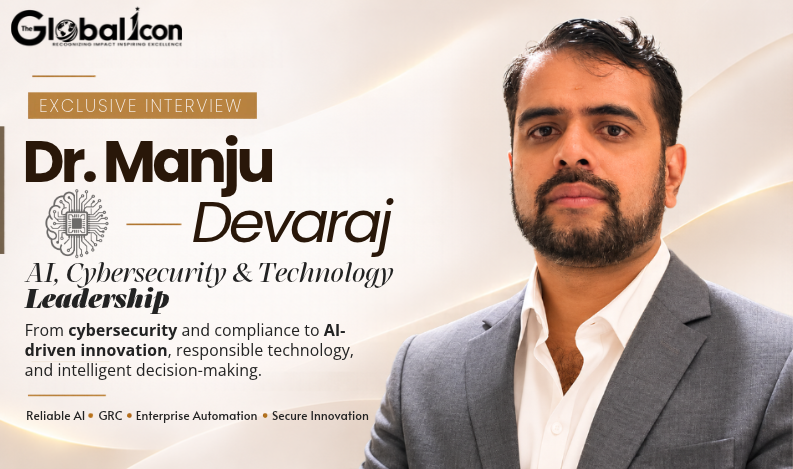
For Dr. Manju Devaraj, technology has never been only about understanding how systems work; it has been about discovering how they can work better, solve real problems, and create wider impact. What began with hands-on experience in technology and enterprise infrastructure gradually expanded into cybersecurity, compliance, governance, leadership, and ultimately the development of AI-driven solutions designed to address real-world challenges.
Across more than two decades in technology, his perspective has evolved alongside the problems he has encountered. Protecting systems led to a deeper understanding of governance; governance highlighted the need for more practical and scalable solutions; and that pursuit eventually brought AI, automation, and intelligent decision-making into the picture. Yet throughout this progression, one idea has remained consistent: technology creates its greatest value when it solves a genuine problem and remains useful, responsible, and accessible.
Today, Dr. Manju’s work reflects a convergence of cybersecurity, human intelligence, automation, and AI, supported by a belief that innovation should multiply expertise rather than simply replace human involvement. His journey also carries lessons about continuous learning, challenging established approaches, learning constructively from failure, and building technology that organisations can genuinely trust.
In this feature, TheGlobalIcon explores the experiences that shaped Dr. Manju Devaraj’s professional evolution, the principles behind his approach to leadership and innovation, the impact he hopes to create through scalable technology, and his perspective on why the next chapter of AI will be defined not simply by how much intelligence we can build, but by how responsibly and meaningfully we use it.
From Protection to Innovation
Dr. Manju Devaraj’s professional journey has evolved from cybersecurity and compliance into technology leadership, entrepreneurship, AI, and product innovation. Over the years, his experience with real-world security, governance, and business challenges has shaped an important belief: identifying problems is not enough. True impact comes from building practical solutions that can solve those problems at scale.
His career has given him exposure to different dimensions of technology, from enterprise networks and infrastructure to cybersecurity, governance, compliance, and strategic leadership. This progression has influenced how he approaches innovation today. Rather than viewing technology only through the lens of protection or compliance, he looks at how it can be developed into practical, intelligent solutions that address wider organisational challenges.
That philosophy has shaped his work in developing AI-driven platforms across cybersecurity, Governance, Risk and Compliance (GRC), enterprise automation, and intelligent decision-making. His academic and research background further strengthens his focus on Reliable AI, responsible innovation, and the practical application of emerging technologies.
In many ways, Dr. Manju describes his journey as a progression from protecting technology, to governing it, to building intelligent technology that creates meaningful impact.
Leading with Practical Innovation
Three principles remain central to Dr. Manju’s approach to leadership and technology:
Innovation must solve a real problem.
AI should augment human intelligence, not blindly replace it.
Technology should be secure, simple, and accessible.
These principles reflect his belief that technological progress should not be pursued simply because a technology is new or powerful. Its value ultimately depends on whether it can address genuine challenges and be used responsibly and effectively.
He strongly believes in combining AI + Human Intelligence + Automation + Security, while keeping professional judgment and accountability at the centre. In this approach, automation and artificial intelligence can provide speed, scale, and efficiency, but human intelligence continues to play an essential role in judgment, ethics, and accountability.
His broader philosophy brings this thinking together in a simple statement:
“Make SMART Technology Affordable and Available for All.”
For Dr. Manju, accessibility is particularly important because the benefits of advanced technology should not remain limited to large organisations with extensive resources. Making intelligent, secure, and practical solutions more accessible can enable a wider range of organisations to strengthen their capabilities and make better decisions.
Expertise into Impact
Receiving the Mahatma Gandhi Leadership Award 2026 for Industry Leadership Excellence in AI-Driven Cybersecurity & Digital Protection Solutions at Oxford was a particularly meaningful recognition for Dr. Manju. Yet when considering the achievement that best represents his impact, he looks beyond individual recognition.
What he values most is the journey from providing expertise to building technology that can multiply that expertise.
Throughout his professional experience, Dr. Manju has worked with complex security, governance, compliance, and technology challenges. Over time, this led to a broader question: how can knowledge and professional expertise be translated into platforms that allow more organisations to benefit from them?
Creating platforms that make cybersecurity, compliance, automation, and intelligent decision-making accessible to more organisations, including small and medium-sized enterprises, represents the kind of impact he values most. Equally important to him is the potential to develop platforms that can positively impact people’s lives.
This shift from providing specialised expertise to creating scalable technology reflects a wider evolution in his journey. The objective is not simply to automate existing processes, but to make valuable capabilities more accessible while preserving the professional judgment and accountability required for their responsible use.
Learning, Challenging and Improving
One of the most important lessons Dr. Manju has learned is to never stop learning and never be afraid to challenge existing ways of working.
Technology, cybersecurity, and artificial intelligence evolve too quickly for professionals or organisations to become comfortable with what they already know. Continuous learning, in his view, is therefore not simply about professional development. It is essential to remaining relevant and capable of responding to emerging challenges.
His journey has also shaped how he views failure.
Rather than treating failure as the opposite of success, Dr. Manju sees it as a potential part of innovation. When people are willing to learn from an unsuccessful outcome, validate what went wrong, and improve their approach, failure can provide valuable insight for the next stage of development.
This mindset encourages experimentation without removing accountability. It is about understanding why something did not work, learning from the evidence, and using those lessons to build something stronger.
Towards Trustworthy AI
Looking ahead, Dr. Manju sees four major trends shaping the future of technology, cybersecurity, and intelligent enterprise systems.
The first is AI becoming an intelligence layer across business and security systems. Rather than operating as an isolated capability, AI is increasingly becoming integrated into the way organisations analyse information, manage risks, automate processes, strengthen security, and support decision-making.
The second is the growing importance of Reliable and Responsible AI. As AI becomes more deeply embedded in organisations, qualities such as explainability, fairness, privacy, traceability, and human oversight will become increasingly important. For Dr. Manju, technological capability alone is not enough. Organisations also need to understand how AI reaches decisions and ensure that appropriate accountability remains in place.
The third major shift is towards continuous cybersecurity and compliance. Traditional periodic assessments are increasingly being challenged by environments where threats, regulations, technologies, and business conditions can change rapidly. Dr. Manju sees real-time assurance and automation playing a greater role in helping organisations continuously understand and manage their security and compliance position.
The fourth trend is the deeper combination of AI + Human Intelligence. Machines can provide extraordinary speed, scale, and analytical capability, while humans bring judgment, ethics, contextual understanding, and accountability. Rather than seeing these capabilities as competing with one another, Dr. Manju believes their combination will define a more practical and responsible direction for intelligent technology.
For him, the future will therefore not simply be about having more AI. It will be about creating more trustworthy and useful AI.
Key Takeaways
- Solve real problems through innovation: Technology creates meaningful value when innovation is directed towards genuine business, security, and real-world challenges.
- Keep human intelligence at the centre: AI can enhance speed, scale, and decision-making, but professional judgment, ethics, and accountability remain essential.
- Make technology accessible: Dr. Manju’s philosophy is to make SMART technology affordable and available for all, extending the benefits of intelligent solutions to a broader range of organisations.
- Turn expertise into scalable solutions: Moving from providing specialised expertise to building platforms that multiply that expertise can create wider and more sustainable impact.
- Treat learning as a continuous process: Rapid changes in cybersecurity, AI, and technology require professionals and organisations to continuously learn and challenge established ways of working.
- Learn constructively from failure: Failure can become part of innovation when organisations validate what went wrong, learn from it, and improve.
- Build AI that can be trusted: Explainability, fairness, privacy, traceability, and human oversight will become increasingly important as AI becomes embedded across business and security systems.
- Move towards continuous assurance: Real-time cybersecurity, compliance, and automation are likely to play a greater role as organisations move beyond periodic assessments.
- Focus on useful AI, not simply more AI: The future of artificial intelligence will depend not only on how powerful it becomes, but on how reliably, responsibly, and practically it can be applied.
Conclusion
For Dr. Manju Devaraj, progress is not measured simply by adopting the newest technology or following the latest industry movement. It is reflected in whether an idea can move beyond theory, address a genuine need, and create an impact that can extend to more organisations and, ultimately, positively influence lives.
That perspective also explains why continuous learning remains important to his journey. In fields where yesterday’s solutions can quickly become tomorrow’s limitations, staying curious, questioning established approaches, and applying lessons from what does not work are essential to building something better.
As technology becomes increasingly embedded in how organisations operate and make decisions, Dr. Manju’s outlook points towards a future where capability must develop alongside responsibility. Speed and scale may come from machines, but judgment, ethics, and accountability cannot become afterthoughts.
The next phase of innovation, therefore, is not simply a race to create more intelligent systems. It is an opportunity to ensure that intelligence is translated into solutions people and organisations can genuinely use, understand, and trust. For Dr. Manju, that is where technology moves beyond advancement for its own sake and becomes a means of creating meaningful, lasting impact.
More Cover Stories:-