

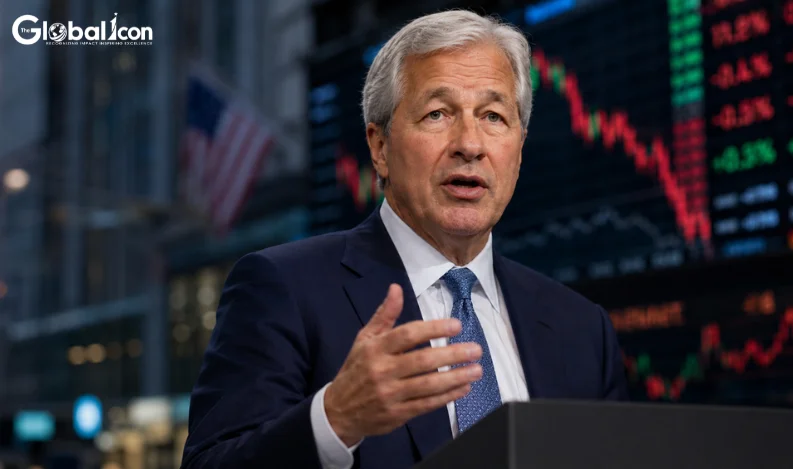
JPMorgan Chase Chief Executive Jamie Dimon has warned that high levels of borrowing across global financial markets could increase the risk of sudden volatility.
Speaking in an interview with CNBC, Dimon said margin debt had reached record levels, while additional borrowing remained hidden under different financial structures.
He pointed to leverage linked to hedge funds, prime brokerages, exchange-traded funds and Treasury arbitrage strategies. According to Dimon, the overall level of market leverage is currently elevated.
The warning comes as investors and regulators examine risks created by expensive equity markets, leveraged hedge-fund positions and large Treasury basis trades.
Dimon said heavily leveraged positions could allow the failure of a single investor or fund to unsettle wider markets. However, he stopped short of describing the current situation as an immediate systemic threat.
His comments followed the reported collapse of AI-focused hedge fund Situational Awareness, which suffered substantial losses after leveraged technology investments moved against it. Margin calls reportedly forced the fund to sell a large part of its publicly traded equity portfolio.
JPMorgan was among the fund’s prime brokers. Dimon said the market’s ability to absorb the failure without wider disruption showed that isolated losses do not always create a financial crisis.
He also differentiated current conditions from the 2008 global financial crisis. Dimon argued that leverage was not the only reason behind that collapse, noting that the scale of underlying mortgage losses played a more significant role.
Banks and clearing houses are likely to increase collateral requirements when market volatility rises, he added. Such measures are commonly used to reduce risk when asset prices become unstable.
Dimon also raised concerns about longer-term inflationary pressures. He identified government deficits, infrastructure spending and increasing global defence expenditure as factors that could maintain demand for capital and push interest rates higher.
According to Dimon, global rearmament could contribute to inflation and encourage investors to demand higher returns for holding long-term government bonds.
His remarks underline growing concerns that high borrowing, expensive assets and changing interest-rate expectations could leave financial markets more vulnerable to sudden shocks.
News Highlights:-