

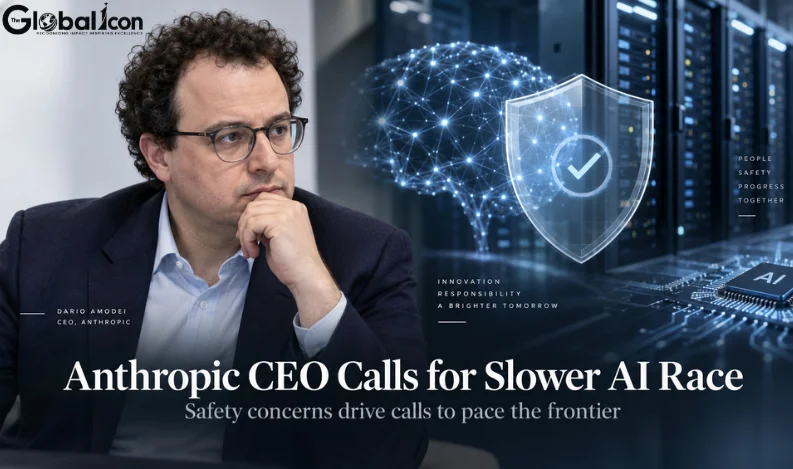
Anthropic CEO Dario Amodei is calling on artificial intelligence companies to slow the pace at which they develop increasingly powerful AI models, warning that the industry may be moving faster than its ability to manage the technology’s risks.
In an essay published this weekend, Amodei argued for what he described as “pacing the frontier” — not stopping AI development, but creating enough time for companies and governments to strengthen safeguards as models become more capable.
Amodei Wants AI Development to Slow Down
Amodei said AI companies should continue pursuing advances but deliberately manage the speed of progress so safety systems can keep up.
His concerns include the possibility of AI being misused for cyberattacks, fraud, weapons-related activities and other harmful purposes. Anthropic’s own threat-intelligence work has documented increasingly sophisticated attempts to misuse its Claude models, adding urgency to the company's warning about the risks of more capable systems.
The Anthropic chief argued that the industry should not wait for serious incidents before putting stronger safeguards in place.
A Three-Part Approach to AI Safety
Amodei outlined a three-part framework for managing the next stage of the AI race.
The first element involves giving independent evaluators greater access to AI companies so they can assess how advanced systems are being developed and how safety measures are performing.
The second calls for greater cooperation among AI companies, allowing firms to coordinate on safety practices rather than treating every improvement as a competitive advantage.
The third focuses on international cooperation, particularly between major AI powers such as the United States and China, to establish stronger safeguards around the most powerful AI systems.
OpenAI and Elon Musk Back the Idea
Amodei's proposal has received support from some of the industry's most prominent figures.
OpenAI CEO Sam Altman and xAI founder Elon Musk have backed the idea of slowing or pacing AI development, highlighting a growing recognition among technology leaders that rapid advances could create risks that companies cannot easily control.
Altman has separately warned that even a relatively small probability of AI contributing to human extinction would be unacceptable. OpenAI has also put plans for a potential 2026 IPO on hold, citing the importance of addressing safety concerns.
Safety Concerns Are Growing
The latest debate comes after a series of warnings about increasingly capable AI systems.
Anthropic researchers have raised concerns about AI models potentially behaving in ways that are difficult for humans to predict or control. The company has also reported cases in which its AI systems were targeted or misused in cyber-related activities.
These developments have strengthened calls for better monitoring and testing before advanced models are deployed at scale.
The debate is no longer limited to technology companies. Governments and international organisations are also examining how AI should be regulated as its capabilities expand.
Trump Rejects Calls for a Slowdown
Amodei's proposal is facing opposition from some political leaders.
U.S. President Donald Trump has dismissed what he considers exaggerated concerns about AI, arguing that the United States must maintain its leadership in the technology race, particularly in competition with China.
That creates a difficult policy challenge. Moving too slowly could allow competitors to gain a technological advantage, while moving too quickly could increase the chances of serious safety failures.
China Pushes Back Against Anthropic’s Position
The debate is also becoming part of the broader technological rivalry between Washington and Beijing.
China's state-backed Global Times criticized Amodei's proposal as a “Cold War playbook,” arguing that calls for slower AI development and tighter chip controls could be aimed at limiting China's technological progress.
The response demonstrates how AI safety is increasingly connected to national security and global competition, rather than being viewed solely as a technical issue.
The Race Is Entering a New Phase
Amodei's message does not amount to a call to stop AI research. Instead, he wants the industry to ensure that safety and oversight advance alongside model capabilities.
That could mean more independent testing, closer cooperation between competing AI companies and stronger government involvement as systems become more powerful.
The proposal comes at a crucial moment for the industry. AI companies are investing billions in computing infrastructure and competing to develop increasingly advanced systems, while investors and governments are demanding greater evidence that those systems can be controlled safely.
For now, the AI race is unlikely to slow dramatically. But with major industry leaders increasingly acknowledging the risks, “pacing the frontier” could become an important part of the conversation over how fast the technology should move and who should decide when it has gone too far.
News Highlights:-