

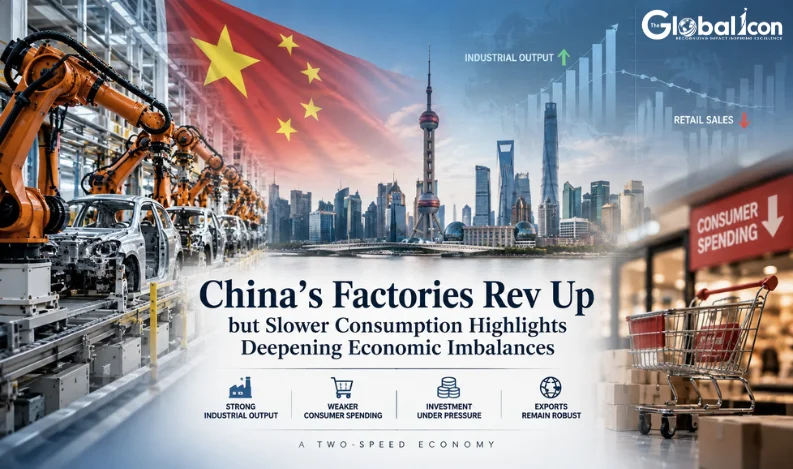
China’s industrial sector showed renewed strength in August, but weaker consumer spending and a deepening investment downturn highlighted a growing imbalance in the world’s second-largest economy.
Industrial output rose 5.2% year on year in August, accelerating from 4.5% in July and beating economists’ expectation of 4.8%. At the same time, retail sales increased just 0.4%, slowing from July’s 0.6% and falling well short of the 0.8% expected by analysts.
Factories Regain Momentum
The improvement in factory activity offers one of the brighter spots in China’s latest economic data.
Manufacturing has continued to benefit from strong demand for products such as electric vehicles, lithium-ion batteries and industrial robotics, as well as robust overseas demand. China’s exports increased 25% in August, helping keep factories busy even as domestic demand remained weak.
The latest production figure also beat market expectations, suggesting that government support and strong export orders are helping parts of the industrial economy maintain momentum.
Consumers Remain Reluctant to Spend
The weakness in retail sales tells a very different story.
Consumer spending rose only 0.4% in August, marking another month of subdued growth. The figure suggests that households remain cautious despite government efforts to encourage consumption.
Weak consumer confidence has been linked to continued problems in the property market, uncertainty about employment and slower income growth. Services and leisure spending have performed better in some areas, but overall household demand has not yet become a strong enough engine of growth.
Investment Down at the Fastest Pace in Years
Investment data provided another warning sign.
Fixed-asset investment fell 7.2% during the first eight months of 2026, marking its sharpest decline in more than six years. The property sector remains a major drag, while private-sector and infrastructure investment have also weakened.
China’s prolonged property downturn has reduced construction activity and damaged confidence among households and businesses. The weakness in investment means factories are increasingly carrying the burden of supporting overall economic growth.
Two-Speed Economy Becomes More Visible
The latest figures highlight what economists increasingly describe as a two-speed Chinese economy.
On one side, manufacturing and exports remain relatively strong. Chinese companies are producing large volumes of increasingly sophisticated goods and finding customers in overseas markets.
On the other, domestic consumption and investment are struggling. That divergence is creating an economy in which industrial production can expand even while households and many domestic businesses remain under pressure.
Property Slump Remains a Major Drag
China’s property crisis continues to sit at the heart of the domestic slowdown.
Falling home prices and weaker construction activity have reduced household wealth and encouraged consumers to save rather than spend. The sector’s weakness is also reducing demand for building materials, machinery and related services.
The imbalance is particularly difficult for policymakers because boosting industrial production alone cannot fully compensate for a lack of demand from Chinese households.
Exports Provide an Important Cushion
Strong overseas demand has helped prevent a sharper slowdown.
China’s exports surged 25% in August, while imports also increased 28.2%. The resulting large trade surplus shows how important international demand has become to the economy.
However, relying too heavily on exports creates its own risks. Growing Chinese shipments are already attracting greater scrutiny from trading partners concerned about industrial overcapacity and the impact of cheap manufactured goods on their domestic industries.
More Stimulus May Be Needed
The latest data is likely to increase pressure on Beijing to strengthen measures aimed at supporting domestic demand.
Chinese policymakers have already introduced programs designed to encourage consumer spending and support investment, but the latest retail and investment figures suggest those measures have yet to produce a broad-based turnaround.
Economists say stronger fiscal support may be needed if the government wants consumption to play a larger role in meeting its economic growth objectives.
China Faces a Difficult Balancing Act
For now, China’s factories are proving more resilient than its consumers.
The acceleration in industrial output is encouraging, particularly as global demand for technology and advanced manufacturing products remains strong. But the sharp fall in investment and very weak retail-sales growth show that the domestic economy is still struggling.
The challenge for Beijing is therefore becoming clearer: maintain the strength of China’s industrial engine while getting households and private businesses spending and investing again.
Without a stronger recovery in domestic demand, the widening gap between booming production and weak consumption could become a deeper structural problem for China’s economy in the months ahead.
News Highlights:-