
Shares of Chinese electric vehicle maker Xpeng fell sharply in Hong Kong on Tuesday after its third-quarter vehicle delivery forecast came in below market expectations, overshadowing a major funding round that valued its robotics business at more than $6.3 billion.
Xpeng shares were down more than 8% in early Hong Kong trading after the Guangzhou-based company forecast third-quarter deliveries of between 115,000 and 121,000 vehicles. The range represents a year-over-year change of roughly a 0.9% decline to a 4.3% increase.
The company also expects third-quarter revenue of between 21.7 billion yuan and 23.4 billion yuan, equivalent to year-over-year growth of about 6.5% to 14.8%.
The outlook disappointed investors who had expected stronger delivery growth as Xpeng works to expand its position in China's intensely competitive electric vehicle market.
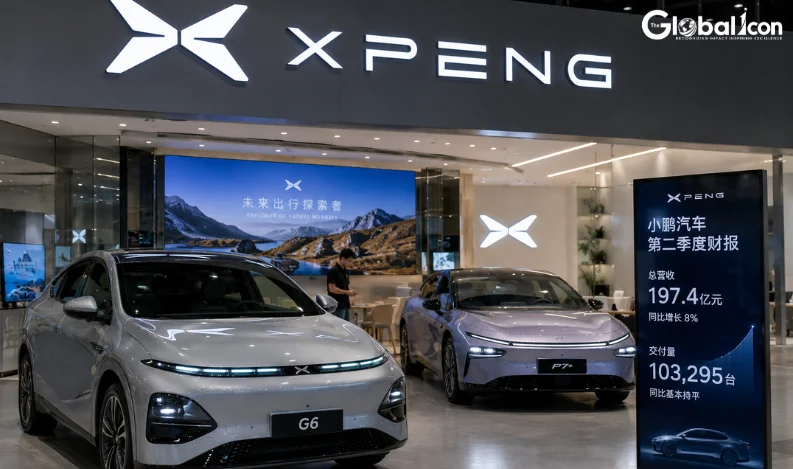
Xpeng reported second-quarter revenue of 19.74 billion yuan ($2.91 billion), up 8% from a year earlier and 51.5% from the first quarter.
Vehicle deliveries reached 103,295 units during the quarter, little changed from 103,181 a year earlier but significantly higher than the 62,682 vehicles delivered during the first three months of 2026.
Despite higher revenue, Xpeng's quarterly net loss widened to 1.34 billion yuan ($200 million) from 480 million yuan in the same period last year. Its gross margin improved to 20.7%, compared with 17.3% a year earlier.
The softer delivery outlook came as Xpeng announced a significant capital raise for its rapidly expanding robotics business.
The company's robotics unit secured more than $900 million in its first private funding round, giving the business a post-money valuation of more than $6.3 billion. Xpeng said the deal represented the largest single-round private financing recorded in China's embodied artificial intelligence sector.
The financing was led by IDG Capital, with participation from Gaorong Ventures and support from Tencent and Alibaba as strategic investors.
Xpeng said the fresh capital would be used to accelerate the development and mass production of humanoid robots, advance its Physical AI models and support the global commercialization of its robotics technology.
The robotics business, operated through subsidiary Dogotix, has become an increasingly important part of Xpeng's strategy as the company expands beyond electric vehicles into artificial intelligence, humanoid robotics and other mobility technologies.
The fundraising also highlights the substantial value investors are placing on Xpeng's emerging technology operations, even as its core automotive business faces pressure.
China's EV sector remains highly competitive, with manufacturers battling for customers through aggressive pricing, frequent model launches and increasingly sophisticated driver-assistance technology. Slower market growth has added further pressure on automakers seeking to protect margins while maintaining sales momentum.
Xpeng had regained market share with its lower-priced Mona lineup, while also expanding overseas. The company said international deliveries exceeded 20,000 vehicles during the second quarter, with overseas markets contributing around 25% of revenue during the first half of 2026.
However, the company's near-term delivery forecast has shifted investor attention back to the performance of its automotive operations.
Xpeng delivered 38,027 vehicles in July, bringing total deliveries for the first seven months of the year to 204,004 units.
The contrast between Xpeng's vehicle outlook and the rapidly rising valuation of its robotics business reflects the company's increasingly diversified technology strategy.
For investors, however, Tuesday's share-price reaction showed that vehicle deliveries and the financial performance of Xpeng's core EV operations remain central to the company's near-term market valuation, even as its ambitions in humanoid robotics attract significant new capital.
News Highlights:-