
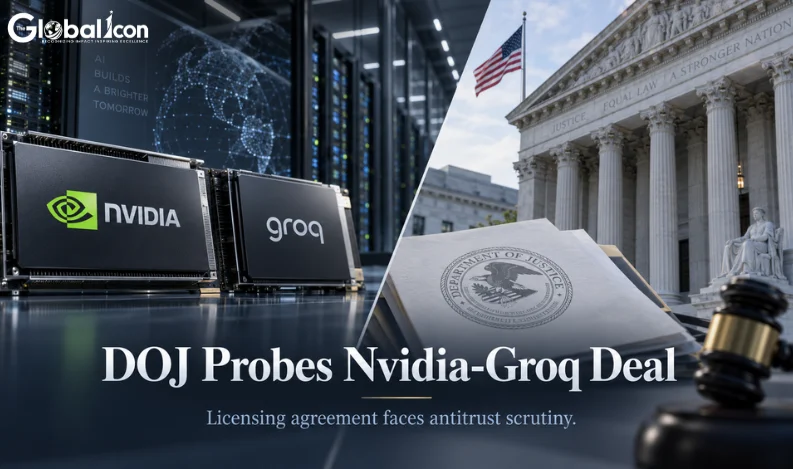
The U.S. Department of Justice is investigating whether Nvidia structured its licensing agreement with artificial intelligence chip startup Groq in a way that avoided antitrust scrutiny, according to a report by The New York Times.
The inquiry is focused on a deal Nvidia announced last year that gave the chip giant a non-exclusive license to Groq’s chip technology and involved hiring several senior Groq executives, including founder Jonathan Ross. Reuters has not independently verified the report.
A $17 Billion Deal Under Review
Nvidia announced the agreement with Groq in December, putting its value at around $17 billion.
Rather than acquiring Groq outright, Nvidia structured the transaction as a licensing arrangement while bringing key members of the startup's leadership and engineering team into the company. That structure has drawn regulatory attention because traditional acquisitions can trigger formal antitrust reviews, while licensing and talent agreements may be treated differently.
According to the NYT report, the Justice Department opened its investigation shortly after the deal was announced and later issued Nvidia a formal demand for information about the transaction.
Why Regulators Are Looking at the Agreement
At the heart of the inquiry is whether Nvidia may have used the structure of the agreement to sidestep regulatory review that could have applied to a conventional acquisition.
Nvidia is already the dominant supplier of advanced graphics processors used to power artificial intelligence systems, giving the company significant influence over the rapidly expanding AI-chip market.
Deals involving emerging competitors or promising AI technologies are therefore receiving greater scrutiny from regulators concerned that major technology companies could strengthen their market positions by acquiring competitors, technology or specialized talent.
Groq Technology Adds Strategic Value
Groq develops specialized chips designed to run AI models quickly and efficiently, particularly for inference, the stage when an AI system processes requests and generates responses.
The technology has attracted attention as companies look for alternatives and complements to traditional AI accelerators. Nvidia's access to Groq's technology and the addition of senior Groq personnel could strengthen its position across an increasingly competitive AI hardware landscape.
The transaction therefore has implications beyond one startup. It reflects the broader race among technology companies to control the computing infrastructure needed for the next phase of artificial intelligence.
Deal May Not Be Reversed
The Justice Department's investigation does not necessarily mean the Nvidia-Groq agreement will be cancelled.
According to the NYT report cited by Reuters, regulators could impose a financial penalty if they determine that Nvidia violated reporting or antitrust requirements. However, the deal is not currently expected to be unwound.
The investigation also remains ongoing, meaning the eventual outcome could change depending on what the Justice Department finds.
Nvidia Faces Growing Regulatory Attention
The Groq inquiry comes as Nvidia's expanding influence across the AI industry attracts increasing regulatory attention.
The company has moved beyond simply selling chips and has been investing in AI platforms, developers and other parts of the technology ecosystem. Earlier this month, Nvidia also announced a $12.93 billion acquisition of AI developer platform Hugging Face, another deal that expands its role in the wider AI market.
As Nvidia's reach grows, regulators are likely to take a closer look at transactions that could affect competition in AI hardware, software and infrastructure.
What Happens Next?
For now, the Justice Department's investigation remains at the information-gathering stage, and there has been no public finding that Nvidia violated antitrust law.
Nvidia has defended the Groq arrangement as part of the American innovation ecosystem, while Groq and the Justice Department have not publicly commented on the reported investigation.
The case could become an important test of how U.S. regulators view modern technology deals that combine licensing agreements with the recruitment of key executives and engineers.
As AI competition intensifies, the Nvidia-Groq inquiry underscores a growing question for the industry: how should regulators evaluate deals that may not look like traditional acquisitions but can still reshape who controls critical technology and talent?
News Highlights:-