
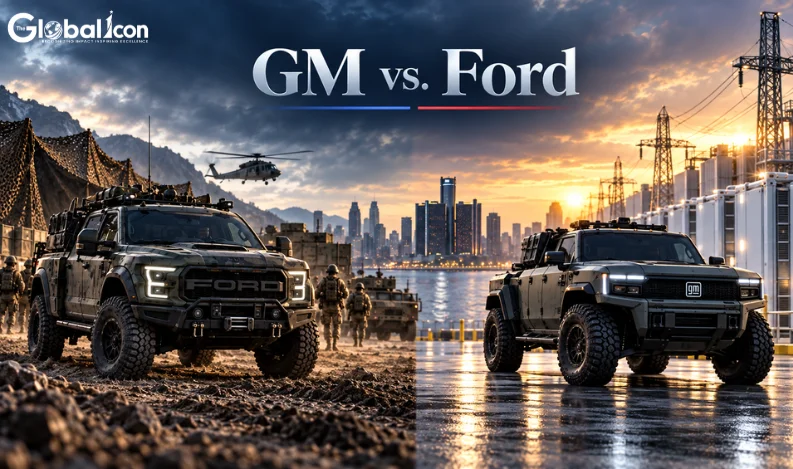
The rivalry between General Motors and Ford Motor is moving well beyond the traditional battle for American car buyers. After more than a century of competing in vehicle sales, trucks and motorsports, the Detroit automakers are now going head-to-head in two very different areas: defense and energy.
Both companies are looking for new sources of growth as the automotive industry faces tougher competition, pressure on margins and rapid changes in technology. Their growing involvement in military vehicles and energy-storage systems is opening a new chapter in one of the most recognizable rivalries in American manufacturing.
Ford Moves Back Into Defense
Ford has joined GM in pursuing U.S. military contracts after the Trump administration encouraged American manufacturers to use their large-scale production capabilities to support the defense sector.
The company is competing to develop military vehicles based on existing commercial platforms. Ford is also targeting opportunities with NATO allies, arguing that common vehicle components could make military fleets easier to maintain and operate across different countries.
Ford is currently competing for the UK Ministry of Defence's Light Mobility Vehicle programme, a contract intended to replace aging military fleets. It has partnered with General Dynamics Land Systems and Ricardo for the bid and plans to use its Ranger pickup platform as the basis for the vehicle.
GM Already Has a Defense Business
General Motors entered this new competition from a stronger starting position.
The company already operates GM Defense, which develops vehicles and technologies for military customers. One example is the Infantry Squad Vehicle, based on the Chevrolet Colorado ZR2 platform and designed to meet U.S. military requirements.
GM is also working with BAE Systems and NP Aerospace on defense opportunities in the UK, putting it directly against Ford in the growing market for military mobility vehicles.
The Pentagon's growing interest in commercial manufacturing expertise could create additional opportunities for both automakers as the U.S. seeks to strengthen and modernize its defense supply chains.
Energy Storage Becomes Another Battleground
The competition is not limited to military contracts.
GM and Ford are also moving into the energy-storage system (ESS) market, where batteries can be used to store electricity for homes, businesses, data centres and utilities.
The technology shares important similarities with electric-vehicle batteries, giving both companies an opportunity to use expertise developed through years of investment in electrification.
Growing electricity demand from data centres and artificial intelligence infrastructure is creating another potential source of demand for large-scale energy storage. At the same time, higher energy costs are increasing interest in systems that can store power and improve resilience.
A New Strategy for a Changing Auto Industry
The move into defense and energy comes as traditional automakers face a difficult global environment.
Chinese manufacturers are becoming stronger competitors, particularly in electric vehicles, while U.S. automakers are dealing with changing consumer demand, supply-chain pressures and uncertainty around government policy. Industry analysts have warned that America's competitive position in automotive manufacturing has weakened considerably.
That makes diversification increasingly attractive. Military contracts can provide access to government-backed demand, while energy storage offers a way to monetize battery and manufacturing capabilities beyond passenger vehicles.
Century-Old Rivalry Takes a New Direction
GM and Ford have spent decades competing over America's best-selling trucks, cars and commercial vehicles. Now, their competition is expanding into industries that are only indirectly connected to traditional automobile sales.
For Ford, the defense push represents a return to an area it largely left behind decades ago. GM, meanwhile, is attempting to build on an existing defense business and expand its role in military technology.
Both companies are also betting that their manufacturing scale can become an advantage outside the traditional auto market.
The next phase of the GM-Ford rivalry could therefore be decided not only on America's roads, but also on military bases, energy networks and emerging industrial markets.
News Highlights:-