
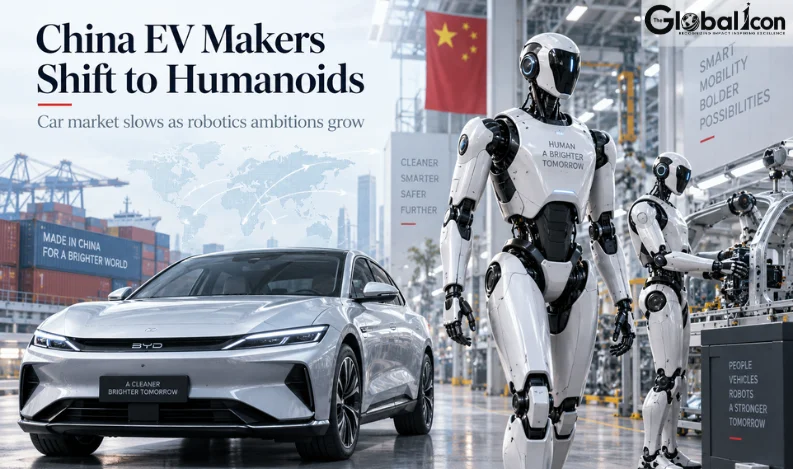
China’s electric-vehicle makers are increasingly looking beyond cars as competition and weaker domestic demand put pressure on the country's automotive industry. A growing number of manufacturers are now turning their attention to humanoid robots, hoping to create a new source of growth from their existing strengths in artificial intelligence, batteries, software and mass production.
The shift comes as China’s domestic passenger-vehicle market continues to struggle. Domestic sales fell 23.7% year on year in August, marking the 11th consecutive monthly decline, while exports surged 77.5%. The contrast is pushing automakers to seek opportunities outside an increasingly crowded home market.
Automakers Take Their EV Expertise Into Robotics
Chinese EV companies have several advantages that can be transferred from vehicle production to humanoid robots.
Automakers already have experience developing electric motors, batteries, sensors, computing systems and sophisticated manufacturing lines. Those technologies are also fundamental to humanoid robots, making robotics a relatively natural extension of their existing businesses.
XPeng is one of the clearest examples. The company has moved its IRON humanoid robot from development toward full-scale production, using manufacturing expertise built through its EV operations. More than 80% of the robot's manufacturing processes at its dedicated facility are automated, according to recent reports.
XPeng plans to deploy the robots at its own facilities later this year, with wider customer availability expected in 2027.
Slowing Car Sales Create Pressure for New Growth
The move into humanoids is happening against a difficult backdrop for China's car industry.
Domestic competition has become intense, with manufacturers frequently cutting prices and launching new models at a rapid pace. While Chinese brands are performing strongly overseas, the crowded home market is making it increasingly difficult for companies to maintain high margins.
Electric and plug-in hybrid vehicle sales were also down 10.1% domestically in August, even as exports of those vehicles jumped 154.7%.
For automakers, robotics offers the possibility of applying their industrial capabilities to a market that is still in an early stage of commercial development.
Humanoid Robot Market Expands Quickly
China’s robotics industry is receiving substantial investment as manufacturers move from demonstrations toward practical applications.
TrendForce estimates that China's humanoid robot market could reach 15 billion yuan ($2.1 billion) in 2026, with growth of at least 60% expected in 2027 as production expands and robots are introduced into industries such as automotive manufacturing, logistics, electronics, energy and aerospace.
That potential has attracted not only traditional robotics companies but also major technology firms and automakers looking to establish a position before the market becomes more mature.
AI Becomes the Next Competitive Battlefield
The robotics push is also closely connected to the rapid development of AI in China.
Automakers are increasingly treating humanoids as physical AI systems that can perform tasks in factories, warehouses, retail environments and eventually homes. This requires a combination of computer vision, machine learning, advanced motors, sensors and high-performance processors.
XPeng's IRON robot, for example, uses the company's own Turing AI processors, giving the automaker greater control over both the hardware and software stack.
That vertically integrated approach mirrors the strategy Chinese EV companies have already used to compete more effectively in the global automotive market.
Investors See Opportunity but Risks Are Growing
The enthusiasm around humanoids has also attracted large amounts of capital.
At the same time, the rapid rise in valuations is beginning to raise concerns about whether the industry is getting ahead of its commercial reality. Chinese regulators have reportedly increased scrutiny of humanoid robotics companies seeking public listings, with concerns over high valuations, losses and a crowded IPO pipeline.
The situation highlights one of the biggest challenges facing the sector: building robots is one thing, but making them reliable, affordable and commercially useful at scale is much harder.
Automakers Bet on Life Beyond Cars
For China's EV manufacturers, the push into humanoid robots is about more than finding another product to sell.
The companies are trying to turn their experience in electric mobility and intelligent vehicles into broader AI and robotics platforms. With domestic car demand weakening, that diversification could become increasingly important to their long-term growth strategies.
China's automakers have already shown how quickly they can scale new technologies once manufacturing and supply chains are in place. The next question is whether they can repeat that success with humanoid robots.
For now, the industry is making a clear bet: as the race to build better electric cars becomes increasingly competitive, the next major opportunity could be found in machines designed to move, work and interact like humans.
News Highlights:-