

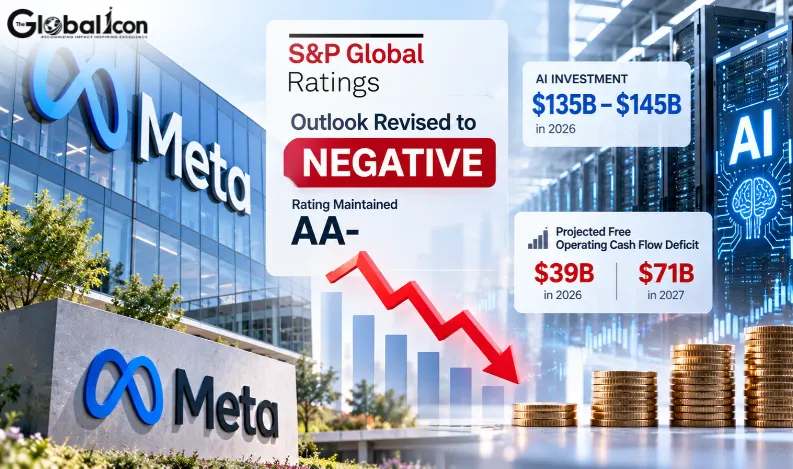
S&P Global Ratings has revised its outlook on Meta Platforms from stable to negative, citing concerns over the company's rapidly increasing artificial intelligence investments and the pressure they are placing on its cash flow. The decision, announced on October 30, 2026, highlights growing uncertainty about whether Meta can generate sufficient returns from its expanding AI infrastructure.
Although S&P maintained Meta's existing AA- credit rating, the negative outlook signals a possibility of a downgrade if the company's financial position weakens further.
Rising AI Investment Raises Financial Concerns
Meta has significantly increased its spending on data centres, computing infrastructure and advanced AI technologies as it competes with other major technology companies.
The company recently forecast capital expenditure of between $135 billion and $145 billion for 2026. This represents a substantial investment in expanding the infrastructure needed to support its AI ambitions.
However, the spending is already affecting its financial performance. Meta reported a free cash flow deficit of approximately $2.12 billion in the third quarter, raising questions about how long the company can maintain its current investment pace without increasing financial pressure.
S&P Forecasts Larger Cash Flow Deficits
S&P Global expects Meta's free operating cash flow deficit to reach approximately $39 billion in 2026 and $71 billion in 2027. The agency warned that elevated investment could keep cash flow negative beyond 2028.
It also expects Meta's financial leverage to increase, potentially exceeding 1.0 times as early as 2027. This is an important threshold for the company's current AA- credit rating.
According to S&P, Meta's ability to monetise its AI investments remains less established than that of some competitors. Companies such as Microsoft and Google can generate revenue by providing cloud and AI computing services to external customers, while Meta's returns are more closely tied to improving its advertising business and developing new AI products.
Meta Disagrees with the Assessment
Meta has pushed back against S&P's concerns, maintaining that its AI investments offer significant opportunities for future business growth.
A company spokesperson said Meta disagrees with the assessment of its AI monetisation capabilities and believes its upcoming products and technologies support its strong credit position.
The company continues to invest in AI-powered advertising tools, infrastructure and new products across its platforms, including Facebook, Instagram and WhatsApp.
What the Negative Outlook Means for Meta
The revised outlook does not mean Meta has immediately lost its AA- credit rating. Instead, it indicates that S&P sees increased financial risks and may consider a downgrade if cash flow remains weak and debt levels continue rising.
The development also reflects a broader challenge facing major technology companies as they compete to build expensive AI infrastructure. While these investments could create new revenue opportunities, the financial returns may take years to materialise.
For Meta, the key challenge will be balancing its long-term AI ambitions with cash flow management, debt levels and investor confidence.
News Highlights:-