

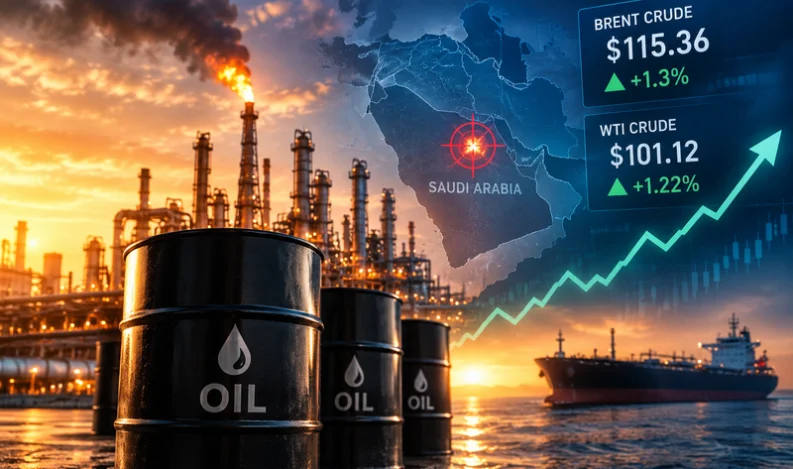
Global oil prices rose on Wednesday as renewed security concerns in Saudi Arabia heightened fears of potential disruptions to crude supplies from the Middle East. The reported missile attack on the kingdom’s largest oil refinery prompted traders to reassess supply risks, pushing benchmark prices higher after a decline in the previous session.
Brent crude futures increased by $1.48, or 1.3%, to $115.36 per barrel, while US West Texas Intermediate (WTI) crude rose $1.22, or 1.22%, to $101.12, according to Reuters market data reported early on October 28, 2026.
Yemen’s Iran-aligned Houthi group claimed responsibility for striking the refinery on Tuesday. Saudi authorities had not immediately confirmed the reported attack, leaving uncertainty over the extent of any damage and its potential impact on production.
Refinery Attack Raises Fears of Supply Disruptions
The refinery reportedly targeted has a processing capacity of approximately 550,000 barrels per day, making it a significant part of Saudi Arabia’s oil infrastructure.
Saudi Arabia is the world’s largest crude oil exporter, and its energy facilities play a crucial role in supplying international markets. Any damage to major refineries, production facilities or export infrastructure could affect the availability of crude oil and petroleum products.
The latest incident follows a series of attacks and security alerts involving Saudi energy infrastructure amid the wider regional conflict involving Iran and its allies. These developments have increased concerns about the safety of oil production facilities and transportation routes.
Even when an attack does not result in a confirmed interruption to exports, the threat of further incidents can prompt traders to demand higher prices to account for possible supply shortages.
Middle East Tensions Keep Energy Markets Volatile
Oil prices have experienced sharp movements as investors respond to changing security conditions and diplomatic developments across the Middle East.
Prices fell by nearly $2 a barrel on Tuesday after diplomatic discussions eased some concerns about regional supply disruptions. Wednesday’s rebound showed how quickly market sentiment can change when fresh security risks emerge.
The Middle East remains central to global energy trade, with major producers and important maritime shipping routes concentrated in the region. Prolonged disruptions could increase transportation costs, delay deliveries and tighten supplies in international markets.
The situation also creates uncertainty for refiners, airlines, shipping companies and manufacturers that depend on stable energy prices. If crude prices remain elevated, businesses may face higher operating costs, while consumers could eventually see increased prices for petrol, diesel and other fuel-dependent products.
US Inventories and OPEC+ Decisions in Focus
Alongside geopolitical developments, traders are monitoring US crude inventories for signs of changes in demand and supply. A Reuters poll of eight analysts indicated that US crude stockpiles were expected to increase by approximately 15,000 barrels for the week ended October 23.
The anticipated increase was relatively small and offered little indication of a major shift in the market’s overall balance. Official inventory data and subsequent revisions could influence prices as traders assess whether US supplies are tightening or expanding.
Attention is also turning to the upcoming OPEC+ meeting, where oil-producing countries are expected to maintain their December production targets, according to sources cited by Reuters.
However, several core members of the group have been producing below their assigned targets. This limits the extent to which announced production quotas necessarily translate into additional barrels reaching the market.
The combination of geopolitical risks, production constraints and uncertain demand continues to complicate the outlook for global oil supplies.
What Higher Oil Prices Could Mean for the Global Economy
A sustained increase in crude prices could put renewed pressure on inflation by raising transportation, manufacturing and energy costs. Countries that depend heavily on imported oil would be particularly exposed to higher international prices and potential currency pressures.
For businesses, expensive fuel can reduce profit margins unless higher costs are passed on to customers. Airlines and logistics companies are especially sensitive because fuel represents a significant portion of their operating expenses.
For oil-producing countries, higher prices can support export revenues, but the benefits depend on production levels, domestic demand and the ability to maintain uninterrupted exports.
Market direction will depend largely on whether the reported attack is confirmed, whether further incidents affect critical infrastructure and how diplomatic efforts progress. A sustained disruption to production or shipping could intensify upward pressure on prices, while reduced tensions and uninterrupted exports could ease concerns.
For now, the latest price increase reflects renewed caution among energy traders rather than confirmation of a major supply loss. Investors will continue monitoring developments in Saudi Arabia, regional shipping routes and OPEC+ production decisions for clearer signals about the next move in oil markets.
News Highlights:-