
Chick-fil-A is expanding rapidly across the United States and into international markets, but CEO Andrew Cathy says one thing is not changing: the company intends to remain a privately held, family-owned business.
Cathy, who became CEO nearly five years ago after succeeding his father, Dan Cathy, said Chick-fil-A has no plans to pursue an initial public offering or bring in outside investors. The approach allows the Cathy family to focus on long-term growth rather than the quarterly expectations faced by publicly traded companies.
Growth Without Giving Up Family Control
Chick-fil-A has grown significantly under Andrew Cathy. The company had roughly 3,000 restaurants at the end of 2025, while its system sales reached about $23.92 billion. Franchise disclosures also showed revenue of $10.3 billion in 2025, up 14% from the previous year.
The chain has continued opening restaurants despite a challenging environment for the wider restaurant industry, where inflation and cautious consumer spending have pressured traffic.
Chick-fil-A opened 179 restaurants in 2025, adding to its growing presence across the U.S. and overseas.
International Expansion Accelerates
The company's ambitions now extend well beyond its traditional U.S. stronghold.
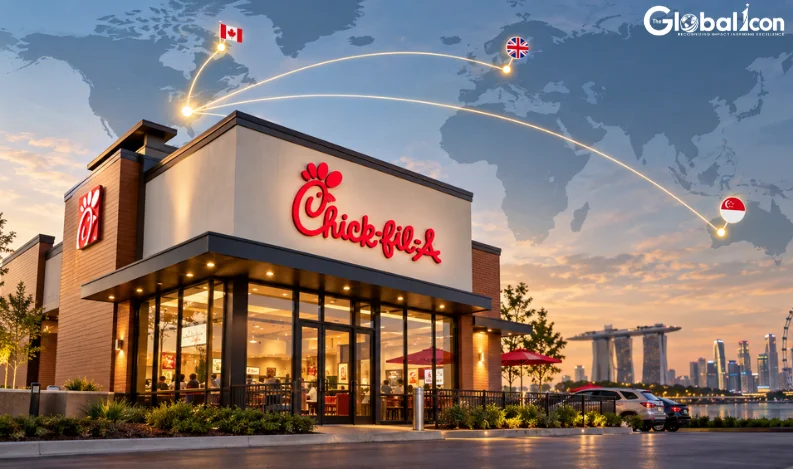
Chick-fil-A has expanded into Canada, the United Kingdom and Singapore, with additional international markets planned through 2030. The company previously announced a $1 billion international expansion plan, including investments of more than $100 million in the U.K. and $75 million in Singapore over the next decade.
The international push represents a major change for a restaurant brand that built its reputation primarily in the American market. Yet Cathy says the company wants expansion to happen in a measured way rather than through uncontrolled growth.
A Conservative Approach to Expansion
Cathy has described Chick-fil-A's strategy as “calculated” and “conservative”, with the company prioritizing the quality of its restaurants and customer experience as it enters new markets.
That philosophy is also reflected in the company's local ownership model. Chick-fil-A says most Owner-Operators run a single restaurant and are directly involved in their local communities. The model is designed to keep restaurants closely connected to customers even as the overall company becomes larger.
The company is also working to convert some licensed locations, particularly in non-traditional settings, toward its Owner-Operator model.
Keeping the Brand's Core Identity
Expansion has not meant abandoning the traditions that helped build the Chick-fil-A brand.
The company continues to close its restaurants on Sundays, a policy established by founder S. Truett Cathy. Andrew Cathy has also emphasized the importance of the company's hospitality-focused culture as it adapts to changing consumer habits.
At the same time, Chick-fil-A is testing new technology and restaurant concepts. Cathy has said the company is exploring artificial intelligence behind the scenes and considering technologies such as drone delivery, while maintaining a “human plus” approach to the customer experience.
New Ideas Beyond the Chicken Sandwich
Chick-fil-A is also experimenting with businesses outside its traditional restaurant model through Red Wagon Ventures, an internal innovation arm.
One of its newer concepts, Daybright, focuses on beverages, coffee, smoothies, juices and doughnuts rather than the company's signature chicken menu. The company has also experimented with other restaurant formats and launched a home repair and maintenance business called Acrew Home Professionals.
The goal is not to move away from Chick-fil-A's core business, but to identify new opportunities that could support the family's long-term growth strategy.
Long-Term Vision Drives the Business
Remaining private gives Chick-fil-A a level of flexibility that many large restaurant chains do not have. Cathy has argued that family ownership allows the company to think in decades rather than focusing primarily on quarterly results.
That approach could become increasingly important as the company expands into unfamiliar international markets while trying to preserve the service and operating standards that made it successful in the U.S.
For Chick-fil-A, the challenge is therefore not simply opening more restaurants. It is finding a way to grow into a global brand without losing the family ownership, local operating model and customer-focused culture that remain central to its identity.
News Highlights:-