

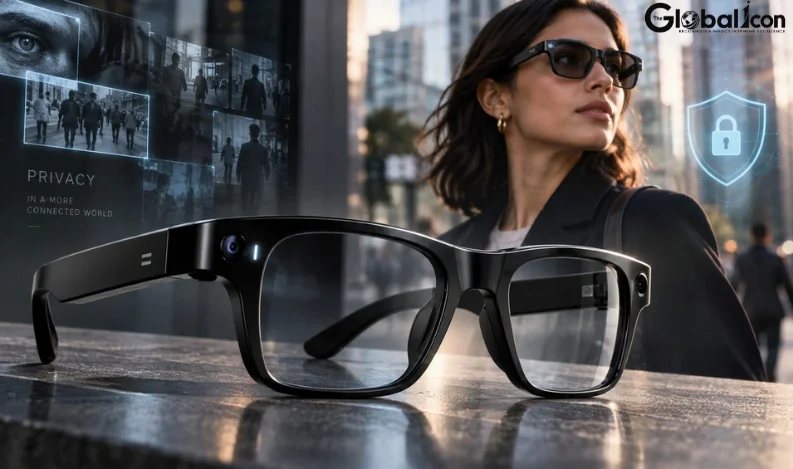
Technology companies are betting that AI-powered wearables could become the next major computing platform after smartphones, but privacy concerns are emerging as one of the biggest obstacles to mass adoption.
Smart glasses, AI pins, pendants and voice recorders are being developed to give users hands-free access to artificial intelligence. Yet the same cameras, microphones and environmental sensors that make these devices useful are also creating concerns about consent, covert recording and the collection of personal information.
Smart Glasses Face the Biggest Privacy Test
The strongest backlash so far has focused on Meta’s AI-enabled Ray-Ban smart glasses, which have helped bring camera-equipped AI eyewear into the mainstream.
The devices can capture photos and video, listen to conversations and interact with Meta’s AI assistant. While Meta says a front-facing capture light signals when the camera is recording and that tampering with the light disables the camera, privacy concerns have continued to grow.
Several venues in the UK have already restricted the glasses, while French authorities have increased scrutiny following allegations involving discreet recording and harassment.
Lawsuit Raises Questions Over Recorded Footage
Meta is also facing a lawsuit alleging that recordings captured by its smart glasses were reviewed by human annotators after being uploaded to company servers.
According to the lawsuit, footage allegedly included highly private situations involving people who appeared unaware they were being recorded. Meta has disputed the allegations and said it uses privacy safeguards, including filtering identifying information and disabling the camera when the capture light is covered or tampered with.
The case illustrates the larger challenge facing wearable AI: people wearing the technology may consent to data collection, but people around them may not.
Companies Search for a More Privacy-Friendly Design
The backlash is prompting technology companies to rethink what AI wearables should look like.
Samsung plans to enter the smart-glasses market later this year through partnerships with Gentle Monster and Warby Parker, while executives at the company have emphasized security and user control.
Some startups are taking the issue even further by removing cameras entirely.
Even Realities, founded by a former Apple engineer, sells camera-free smart glasses designed to provide AI features without continuously recording the surrounding environment. The company says consumer concerns about covert recording are becoming an increasingly important factor in the market.
AI Pins and Recorders Offer Another Approach
Other companies are experimenting with devices that make recording more deliberate.
San Francisco-based Pocket has developed a phone-mounted AI recorder that requires the user to press a button before capturing conversations. The company says about 170,000 devices were in use eight months after launch, including among employees at companies such as DoorDash, Michelin and Santander.
Plaud has also focused on visible recording controls. Its wearable AI recorder activates only when deliberately triggered and can notify people nearby with lights or an audio announcement. The company says it has 2.5 million users and more than $100 million in annual recurring revenue.
OpenAI Sees Local Processing as the Long-Term Answer
OpenAI CEO Sam Altman has described a future in which an always-on AI device could understand a user's surroundings and know when to assist.
But Altman has also argued that such technology cannot depend entirely on cloud processing if users are expected to trust it. He has said sensitive information should ultimately be processed locally on the device, although reaching that level of capability may take several more years as hardware improves.
Local processing could reduce the amount of personal information sent to company servers, but it also requires more powerful and efficient hardware.
The Smartphone Market Is the Prize
The stakes are enormous for technology companies.
The industry is competing for a share of a smartphone market worth more than $600 billion, according to the Reuters analysis. Companies see AI wearables as a potential way to shift everyday computing away from screens and toward more natural interactions with the physical world.
Instead of opening an app, users could simply ask an AI assistant to perform a task, identify an object, translate a conversation or provide information about their surroundings.
But those capabilities require devices to constantly observe or listen, creating a fundamental tension between convenience and privacy.
Businesses May Adopt the Technology Faster
While consumers remain cautious, some AI wearable companies are seeing stronger interest from businesses.
Workplaces can establish clearer rules about when recording is permitted and how data should be handled, making professional environments potentially easier markets for these devices than public spaces.
Companies are therefore experimenting with voice recorders, smart glasses and other AI hardware for meetings, documentation, customer service and workplace assistance.
Trust Could Decide the Next Computing Platform
Privacy concerns are not entirely new. Smartphones initially faced similar worries when cameras and microphones became common, but eventually became an accepted part of everyday life.
The difference with AI wearables is that these devices can potentially see and hear continuously while appearing almost indistinguishable from ordinary accessories.
That makes visible recording indicators, user controls, local processing and clear consent policies increasingly important to their future.
AI Wearables Face a Crucial Test
The technology industry is moving quickly toward a world in which AI is no longer confined to phones and computers.
Smart glasses, AI pins, pendants and recorders could eventually become everyday assistants, but their success will depend on whether people trust them around others as well as in their own homes.
For now, manufacturers are experimenting with different designs and privacy protections. The challenge is clear: the more AI devices can see and hear, the more useful they may become, but without convincing privacy safeguards, those same capabilities could prevent them from becoming mainstream.
News Highlights:-