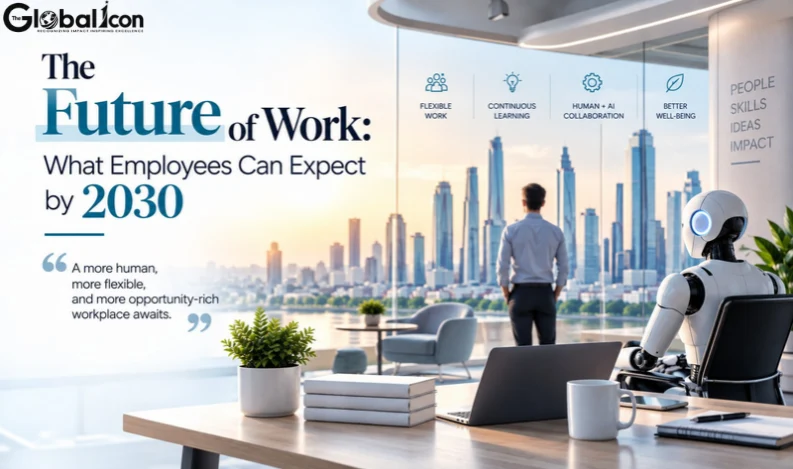
The world of work is changing faster than at any point in recent decades. Artificial intelligence, automation, digital collaboration, changing employee expectations, and new business models are reshaping not only the way people work but also the skills, responsibilities, and career paths that will matter in the years ahead.
By 2030, the workplace is expected to look noticeably different from what many employees experience today. Some tasks will become automated, new roles will emerge, and traditional job descriptions will continue to evolve. In many industries, professionals may work with AI-enabled systems on a daily basis, while organizations place greater value on adaptability, problem-solving, communication, and measurable outcomes.
The biggest change, however, may not be the disappearance of jobs. It may be the transformation of work itself.
The future of work will not be about humans competing with technology. It will be about how effectively people use technology while strengthening the skills that remain uniquely human.
Employees who understand this shift early will be in a stronger position to adapt, grow, and remain relevant in an increasingly dynamic labor market.
What Does the Future of Work Really Mean?
The phrase “future of work” is often associated with artificial intelligence, remote jobs, and automation. In reality, it covers a much broader transformation.
The future of work includes changes in how companies hire, how teams collaborate, where employees work, how performance is measured, what skills employers value, and how careers develop over time. Technology is an important part of this transformation, but so are changing workforce expectations, global competition, demographic shifts, and the growing demand for flexibility.
By 2030, employees are likely to experience several major changes:
- Greater use of AI and automation
- More emphasis on skills rather than job titles
- Continued growth of flexible and hybrid work models
- Increased demand for continuous learning
- More outcome-based performance measurement
- Stronger focus on adaptability and human skills
- More global competition for knowledge-based work
These changes will not affect every industry equally, but almost every profession is likely to be influenced in some way.
AI Will Become Part of Everyday Work
Artificial intelligence is already being used in areas such as writing, design, finance, software development, customer service, healthcare, marketing, research, and administration. By 2030, AI may no longer feel like a separate tool. It is likely to be built directly into the systems employees use every day.
An employee may begin the day with an AI assistant that summarizes important emails, organizes priorities, prepares an initial report, highlights unusual data, and suggests next steps. A marketer may use AI to analyze customer behavior and prepare campaign variations. A financial analyst may use automated tools to process large datasets before interpreting the results. A software developer may use AI-generated code while focusing on architecture, security, and product decisions.
This shift does not automatically reduce the importance of human employees. It changes where their value is concentrated.
Instead of spending large amounts of time on repetitive execution, employees may spend more time on:
- Decision-making
- Strategic thinking
- Client communication
- Creative direction
- Problem-solving
- Leadership
- Interpretation
- Relationship management
AI is likely to automate routine work first, while human value increasingly moves toward judgment, context, creativity, and responsibility.
For many professionals, this could improve the quality of work by reducing time spent on repetitive tasks.
Routine Tasks Will Decline
One of the clearest workplace changes by 2030 will be the reduction of routine digital work.
Activities such as basic data entry, document formatting, scheduling, repetitive reporting, simple analysis, note-taking, and standard customer communication are increasingly suitable for automation.
This means some job roles may become smaller, while others are redesigned around more complex responsibilities.
For example, an administrative professional may spend less time organizing calendars and more time coordinating people and priorities. A customer service employee may handle fewer basic questions but more difficult cases. An accountant may spend less time processing transactions and more time providing financial insight.
The most vulnerable employees will not necessarily be those in a particular industry. They will be those whose jobs depend heavily on predictable and repeatable activities.
This is why professionals should begin asking a practical question:
Which parts of my current job can technology already perform, and which parts still require human expertise?
The answer can provide a useful guide for future career development.
Human Skills Will Become More Valuable
As technology handles more structured tasks, human capabilities may become even more important.
Employers will continue to need people who can understand context, manage relationships, make decisions in uncertain situations, communicate effectively, and take responsibility for outcomes.
Some of the most valuable skills by 2030 are likely to include:
- Critical thinking
- Communication
- Emotional intelligence
- Creativity
- Leadership
- Negotiation
- Strategic reasoning
- Problem-solving
- Adaptability
- Collaboration
These skills are difficult to automate because they depend on human behavior, context, trust, and experience.
A machine can summarize information, but a person still needs to decide what matters. AI can generate ideas, but a professional still needs to determine which idea is appropriate. Technology can produce recommendations, but someone must take responsibility for the final decision.
Employees who combine strong human capabilities with technology are likely to become particularly valuable.
Skills May Matter More Than Job Titles
Traditional careers have often been built around qualifications, job titles, and years of experience. These factors will continue to matter, especially in regulated or highly specialized professions, but employers are increasingly interested in what a person can actually do.
By 2030, hiring and promotion decisions may place greater emphasis on practical skills, measurable results, and adaptability.
Two people may hold the same job title but have very different levels of value. One may understand only the traditional responsibilities of the role, while another may also know how to use automation, analyze data, communicate across departments, and solve complex problems.
This shift could make portfolios, certifications, case studies, completed projects, and demonstrated results more important in certain industries.
The future career question may become less about “What is your title?” and more about “What value can you create?”
For employees, this means building transferable skills rather than relying entirely on a single job description.
Continuous Learning Will Become Essential
One of the most significant career changes by 2030 will be the growing importance of continuous learning.
In the past, many professionals could rely on the same knowledge and methods for long periods. That is becoming increasingly difficult as technology, customer behavior, regulations, and business models change more quickly.
Learning may therefore become a permanent part of professional life.
Employees may need to regularly update their knowledge through:
Short professional courses
- Industry certifications
- Internal training
- Digital learning platforms
- Mentorship
- Project-based learning
- Workshops
- AI-assisted education
- Professional communities
This does not mean everyone will need to return to university repeatedly. It means successful professionals will need to develop a habit of learning.
The ability to understand a new tool, process, or business problem quickly may become one of the strongest forms of career security.
Hybrid and Flexible Work Will Continue to Evolve
Remote work and hybrid work have already changed workplace expectations. By 2030, these models are likely to become more mature rather than simply disappear.
Different companies will adopt different approaches. Some industries will remain highly office-based, especially where physical equipment, regulation, or face-to-face operations are essential. Others will continue to support remote or distributed teams.
Many organizations may use a more purpose-based model.
Employees might work remotely when individual focus is required and come together for:
- Strategy meetings
- Team development
- Creative workshops
- Training
- Client meetings
- Collaboration
- Relationship-building
The office may therefore become less about where routine work happens and more about where people connect.
For employees, this can bring greater flexibility, but it may also come with stronger expectations around performance.
The future workplace could offer more freedom while demanding greater accountability.
Performance Will Be Measured by Results
Traditional workplaces often placed significant emphasis on visible activity. Arriving early, staying late, attending meetings, and appearing busy were sometimes treated as signs of commitment.
By 2030, that approach may become less relevant.
AI and automation can allow employees to complete tasks more quickly. Hybrid work also makes it more difficult to judge performance based purely on physical presence.
As a result, employers may increasingly focus on outcomes such as:
- Projects completed
- Revenue generated
- Customer satisfaction
- Problems solved
- Improvements created
- Quality of decisions
- Team contribution
- Client retention
- Innovation
- Business impact
This could create fairer workplaces for people who work efficiently, but it may also create new pressure if companies set unrealistic performance expectations.
The challenge will be finding a balance between accountability and sustainable workloads.
Managers Will Need to Become Better Leaders
Management itself is likely to change.
Many traditional management responsibilities, such as tracking tasks, reviewing routine reports, and monitoring deadlines, can increasingly be supported by digital tools.
This means managers will need to contribute more through leadership rather than supervision.
By 2030, effective managers may be expected to:
- Set clear priorities
- Coach employees
- Develop talent
- Resolve conflict
- Communicate strategy
- Build trust
- Support collaboration
- Manage change
- Make difficult decisions
- Create strong team cultures
As technology becomes better at managing information, managers will need to become better at managing people.
Employees are likely to place greater value on leaders who can provide direction, clarity, and support in a fast-changing environment.
Careers Will Become Less Linear
The traditional career path once looked relatively simple: join a company, gain experience, earn promotions, and gradually move into senior positions.
By 2030, careers may become more flexible and less predictable.
Professionals may move between industries, change specializations, take on consulting work, build side businesses, return to education, or work on project-based assignments.
Some employees may build what are sometimes called portfolio careers, where income and professional identity come from multiple sources rather than a single job.
This means employees may need to take more responsibility for managing their own careers.
Useful questions to ask regularly include:
- Are my skills becoming more valuable?
- Is my role becoming more automated?
- What new capability should I learn next?
- Could my skills transfer to another industry?
- What am I becoming known for professionally?
Career development may increasingly become something employees actively design rather than something employers automatically provide.
Entry-Level Jobs May Change Significantly
One of the biggest challenges of the future of work will be the transformation of entry-level roles.
Junior employees have traditionally learned through basic research, simple analysis, administrative tasks, first drafts, routine coding, scheduling, and document preparation.
These are also among the tasks most likely to be automated.
This creates an important question: if AI handles more junior-level work, how will younger employees gain the experience needed to become future specialists and leaders?
Organizations may need to redesign entry-level careers around:
- Mentorship
- Apprenticeships
- Cross-functional projects
- Client exposure
- Practical problem-solving
- Supervised decision-making
- Earlier responsibility
- AI-assisted workflows
Young professionals may also need to enter the workforce with stronger communication, digital literacy, and practical experience than previous generations.
A degree will remain valuable, but it may no longer be enough on its own.
Global Competition for Talent Will Increase
Digital collaboration makes it easier for companies to hire people from different countries.
By 2030, more employees in knowledge-based industries may find themselves competing and collaborating with professionals around the world.
This creates both opportunity and pressure.
A skilled professional can potentially work for an organization in another country without relocating. At the same time, companies can recruit from a much larger talent pool.
As a result, professionals may need to differentiate themselves through:
- Specialized expertise
- Strong communication
- Reliable performance
- Professional reputation
- Cultural awareness
- Digital collaboration skills
The workplace is becoming more global, and careers are becoming less dependent on geography.
Personal Reputation Will Matter More
As careers become more flexible, employees may increasingly need professional reputations that extend beyond their current employer.
This does not mean everyone must become a social media personality.
Professional visibility can come through:
- Industry articles
- Conferences
- Case studies
- Research
- Speaking engagements
- Professional communities
- Portfolio work
- Thought leadership
A strong professional reputation can create opportunities, strengthen credibility, and reduce dependence on a single employer.
The most important factor is not popularity. It is trust.
Employee Well-Being Will Become a Business Priority
Technology can improve productivity, but it can also increase pressure.
Constant communication, digital monitoring, high workloads, and always-on expectations can create burnout if poorly managed.
By 2030, successful employers are likely to treat employee well-being as a business issue rather than simply an HR benefit.
Companies may need to pay greater attention to:
- Workload management
- Mental health
- Digital boundaries
- Flexible schedules
- Manager quality
- Focus time
- Work-life balance
- Employee engagement
Organizations that use AI only to demand more output may struggle to retain talented employees.
Those that use technology to eliminate low-value work and improve employee experience may gain a stronger competitive advantage.
What Employees Should Do Now
Preparing for 2030 does not require predicting every future trend. Employees can focus on practical actions that improve resilience across different scenarios.
Learn the technology affecting your profession
You do not need to become an AI engineer, but you should understand the tools changing your industry.
Move beyond repetitive execution
Try to build responsibilities in strategy, interpretation, communication, leadership, and problem-solving.
Strengthen transferable skills
Capabilities such as communication, critical thinking, project management, adaptability, and relationship-building remain useful across industries.
Keep learning
Treat professional development as an ongoing responsibility.
Build visible evidence of your work
Maintain examples of projects, achievements, results, and successful initiatives.
Develop strong relationships
Professional networks continue to create opportunities that qualifications alone cannot guarantee.
What Will Employers Value Most by 2030?
The ideal employee of 2030 is unlikely to be defined only by technical expertise or hard work.
Employers are likely to value professionals who can:
- Learn quickly
- Adapt to change
- Use technology responsibly
- Communicate clearly
- Solve unfamiliar problems
- Work independently
- Collaborate effectively
- Make sound decisions
- Take ownership
- Build relationships
- Continue developing
Perhaps the most important skill will be knowing when to trust technology and when to challenge it.
AI can be powerful, but it can also be incomplete, inaccurate, or poorly suited to a particular situation.
Human judgment will remain essential.
Final Thoughts: The Workplace of 2030 Will Reward Adaptability
The future of work is unlikely to be defined by one dramatic change. It will be shaped by many smaller transformations happening at the same time.
AI will become part of everyday workflows. Routine tasks will decline. Human skills will become more valuable. Hybrid work will mature. Careers will become less linear. Skills will matter more than traditional titles, and employees will need to keep learning throughout their careers.
Some professions will change significantly, but change does not automatically mean decline.
For many employees, technology can remove repetitive work and create more time for higher-value responsibilities involving creativity, strategy, leadership, and relationships.
The most important lesson is simple:
Career security in 2030 will depend less on protecting a fixed job description and more on building skills that remain valuable as work continues to evolve.
Employees who stay curious, build strong human capabilities, and learn how to work intelligently with technology will be better positioned for the opportunities ahead.
The future of work is not something that suddenly begins in 2030.
It is already being created now.
Frequently Asked Questions
What will work look like in 2030?
Work is likely to become more AI-enabled, skills-focused, flexible, and outcome-driven. Employees may use intelligent tools more frequently while focusing more on judgment, communication, leadership, and problem-solving.
Will AI replace most jobs by 2030?
AI is more likely to automate specific tasks and change job descriptions than eliminate most professions completely. Roles built mainly around repetitive and predictable tasks face the greatest risk.
What skills will be important by 2030?
Critical thinking, communication, adaptability, AI literacy, leadership, creativity, emotional intelligence, problem-solving, and industry expertise are likely to remain highly valuable.
Will remote work continue?
Remote and hybrid work are likely to remain part of many industries, although individual companies will adopt different policies depending on the nature of their work.
Will degrees still be important?
Degrees will remain essential in many specialized and regulated professions. However, employers may increasingly consider practical skills, certifications, projects, and measurable results alongside formal qualifications.
How can employees prepare for the future of work?
Employees should understand how technology is changing their profession, continuously update their skills, build strong human capabilities, develop industry expertise, and move toward work that requires greater judgment and responsibility.
Featured Articles:-