
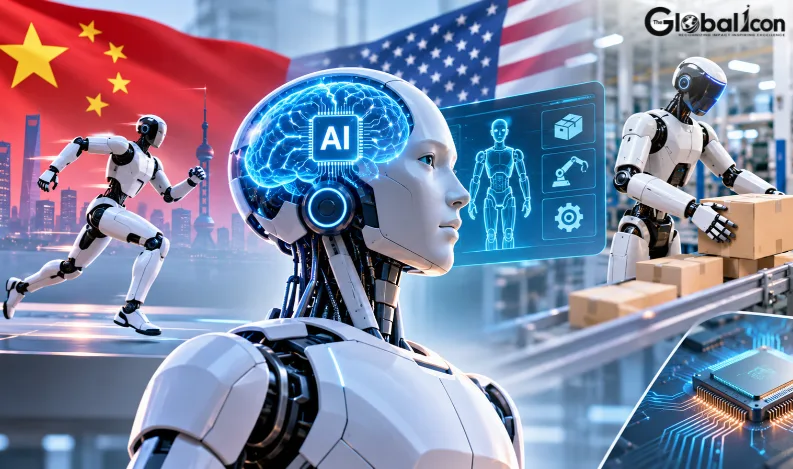
China's humanoid robotics industry is entering a new phase as companies shift their focus from impressive physical performances to developing artificial intelligence that can make robots more intelligent, adaptable and useful in everyday work.
After years of showcasing robots capable of running, dancing and performing backflips, Chinese manufacturers are investing heavily in embodied AI, a technology that enables machines to understand their surroundings, learn unfamiliar tasks and respond to changing situations without requiring detailed programming for every movement.
The shift is creating a new competitive landscape in which success will depend not only on building advanced robot hardware but also on developing the software that controls it.
Investment in Robot Intelligence Accelerates
China's embodied AI sector attracted approximately 93.5 billion yuan ($13 billion) across 322 investment deals during the first half of 2026, according to data research firm ITjuzi. The investment was around five times higher than the amount recorded during the same period a year earlier.
Companies such as X Square, Galaxea and Spirit AI are developing advanced systems designed to help robots perform different tasks using shared intelligence rather than specialised programming.
The growing investment reflects expectations that the next major breakthrough in robotics will come from AI models capable of transferring knowledge between tasks, environments and different types of machines.
China and the United States Compete for the Robot Brain
The race is also becoming another important area of technological competition between China and the United States.
American companies, including Physical Intelligence, Skild AI and Generalist, are developing AI systems that allow robots to learn multiple skills with less retraining. Meanwhile, Chinese developers are relying on their manufacturing networks, industrial partnerships and access to real-world training environments.
Chinese companies are collecting physical-task data through human demonstrations, wearable sensors and computer simulations. This information helps robots understand activities such as gripping objects, handling cables and moving items between locations.
However, gathering large quantities of data is not enough. Training quality, computing power and the ability to transfer learned skills into real-world environments remain major challenges.
From Impressive Demonstrations to Practical Applications
Several Chinese companies are already testing embodied AI in industrial and commercial settings.
Spirit AI robots are being used in battery-pack testing operations at a CATL facility, where they reportedly connect flexible wires. Ant Group's robotics unit, Robbyant, has also developed systems used to handle orders at pharmacies in Shanghai, with employees checking medicines before dispatch.
These applications demonstrate how robotics companies are moving beyond entertainment and demonstrations towards tasks that could generate measurable business value.
Nevertheless, reliable performance in unfamiliar environments remains difficult. Robots must be able to recognise objects, recover from mistakes and complete tasks without constant human intervention.
Chip Shortages and Training Challenges Remain
China's robotics industry also faces obstacles related to access to advanced computing chips. US export controls on high-performance processors could limit the ability of Chinese developers to train increasingly sophisticated AI models.
Companies are responding by improving software efficiency, using synthetic training data and exploring domestic chip alternatives. However, questions remain about whether these approaches can fully compensate for limited access to advanced computing infrastructure.
Another challenge is the cost and quality of physical training data. Unlike chatbots, robots must learn from real-world interactions involving movement, balance, touch and object manipulation.
The Search for a ChatGPT Moment in Robotics
Industry leaders believe robotics could eventually experience a breakthrough comparable to the launch of ChatGPT, making intelligent machines capable of handling a much wider range of tasks through simple instructions.
However, experts caution that successful demonstrations do not automatically translate into dependable commercial products. Robots will need to perform consistently across different workplaces and unfamiliar situations before businesses can rely on them at scale.
For China's robotics manufacturers, the next stage of competition is therefore clear: building machines that can do more than move impressively. The companies that develop reliable AI capable of understanding, learning and acting in the physical world could shape the future of the global robotics industry.
News Highlights:-