
Alibaba is dramatically expanding its artificial intelligence ambitions, announcing plans to train a new AI model with 5 trillion to 10 trillion parameters while unveiling a new homegrown AI chip designed to support increasingly demanding workloads.
Alibaba Group CEO Eddie Wu announced the plans at the 2026 Apsara Conference in Hangzhou, outlining a broader strategy built around AI models, computing chips and data-centre infrastructure. The proposed model would be more than twice the size of Alibaba’s current flagship Qwen 3.8 Max, which has 2.4 trillion parameters.
Alibaba Targets a New Scale of AI Models
Parameters are one way of measuring the size of an AI model, representing the numerical values the system learns during training.
Alibaba’s planned 5 trillion to 10 trillion parameter model would place it among the largest AI systems publicly discussed by a major technology company. Wu said upcoming models, including Qwen 4.5 and Qwen 5, are intended to handle increasingly complex tasks and push the company's research closer to what it describes as artificial superintelligence.
The company is also working on models with stronger recursive self-improvement capabilities, an area that has become an important focus in the global AI race.
New Zhenwu V900 Chip Unveiled
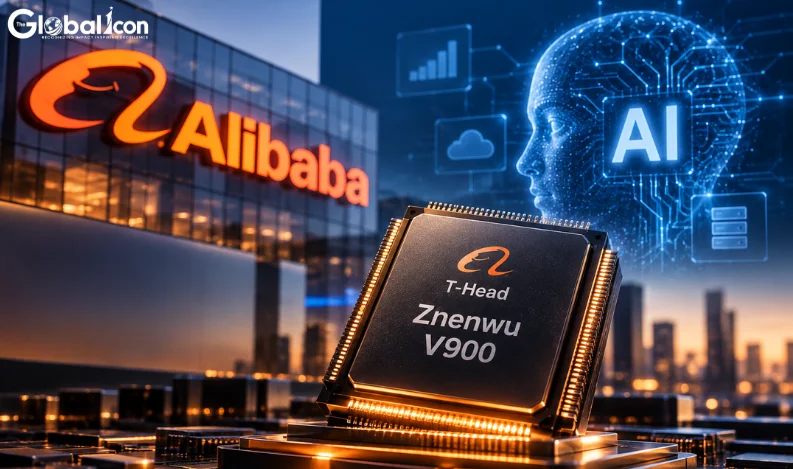
Alongside its model plans, Alibaba introduced the Zhenwu V900, a new AI chip developed by its semiconductor division T-Head.
Alibaba describes the chip as the most powerful AI processor developed in China so far and says it delivers around three times the performance of its predecessor. The company expects the V900 to enter mass production in early 2027.
The chip is designed to provide Alibaba with more control over its AI computing infrastructure as the company increasingly relies on large-scale domestic hardware.
M890 Supernodes Already Support Huge Models
Alibaba is also building larger computing systems by connecting multiple AI chips.
Its proprietary M890 AI supernode can already support inference for models containing more than 2 trillion parameters, according to the company. That capability requires substantial computing power and high-speed connections between processors.
The development is important because simply creating a large AI model is not enough. Companies also need enormous amounts of computing capacity to train, run and update those systems efficiently.
Data Centres Become a Major Part of the Strategy
Alibaba's AI expansion is also driving a major investment in cloud infrastructure.
The company said it plans to increase Alibaba Cloud's global data-centre capacity to more than 20 gigawatts by 2032. That would significantly expand the computing resources available to support AI customers and Alibaba's own models.
The strategy reflects a broader industry trend in which AI development is increasingly tied to access to electricity, data centres, networking equipment and advanced processors.
China Pushes for Greater AI Hardware Independence
Alibaba's chip strategy comes as Chinese technology companies face continued restrictions on access to some advanced U.S.-designed AI processors.
Companies including Huawei and Alibaba have been investing heavily in domestic alternatives as Beijing pushes for greater technological self-reliance. Alibaba's new chip is therefore aimed not only at improving its own AI capabilities but also at strengthening China's broader domestic computing ecosystem.
The timing comes as competition between Chinese and U.S. technology companies continues to intensify across AI models, chips and data-centre infrastructure.
Alibaba Builds an AI Ecosystem
The company's announcements show that Alibaba is pursuing AI across the entire technology stack rather than concentrating only on software.
Its strategy now includes large language models, custom AI chips, cloud computing, supernodes and global data centres. By developing these pieces together, Alibaba aims to reduce its reliance on outside suppliers while giving customers access to an integrated AI platform.
The approach mirrors strategies being adopted by other major technology companies globally, which are increasingly investing in their own chips and data-centre infrastructure to meet rapidly growing AI demand.
The AI Race Moves Toward Massive Computing
Alibaba's ambitions highlight how quickly the scale of AI development is increasing.
The company's proposed 5 trillion–10 trillion parameter model would require substantial computing resources, making the development of faster chips and larger data centres essential. At the same time, the push raises questions about the cost and energy requirements of building increasingly large AI systems.
For Alibaba, however, the direction is clear. The company is betting that larger and more capable models, combined with proprietary hardware and expanded cloud infrastructure, will help strengthen its position in the global AI market.
With the Zhenwu V900 expected to enter mass production in 2027 and new Qwen models under development, Alibaba is positioning its next phase of growth around a much larger AI ecosystem.
News Highlights:-