

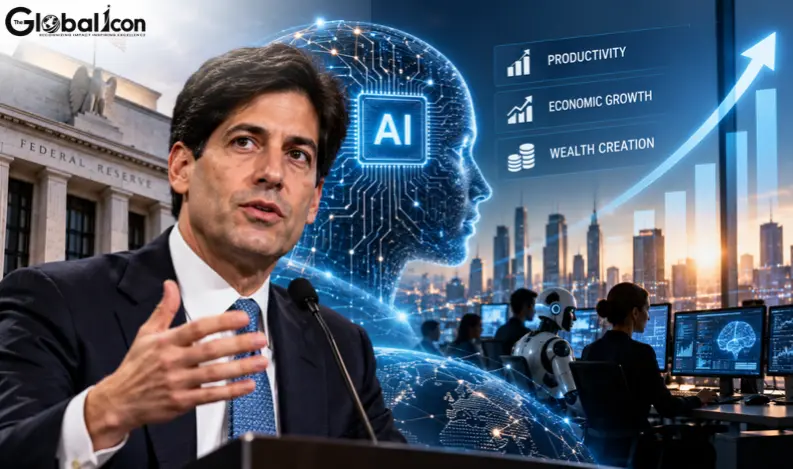
Federal Reserve Chair Kevin Warsh has warned that artificial intelligence (AI) will bring significant disruption to the economy, even as he remains optimistic about its long-term benefits for productivity and wealth creation. Speaking on October 16, 2026, during a discussion with International Monetary Fund Managing Director Kristalina Georgieva, Warsh described AI as one of the most consequential economic changes of his lifetime.
Warsh Highlights AI’s Long-Term Economic Potential
Warsh said AI could transform how businesses operate, produce goods and deliver services. By automating routine tasks and helping workers complete complex activities more efficiently, the technology could increase productivity and support stronger economic growth.
Higher productivity can allow companies to produce more with fewer resources, potentially improving profitability, raising incomes and creating new business opportunities. Warsh believes these developments could ultimately strengthen wealth creation across the US economy.
However, he cautioned that the benefits would not arrive smoothly or immediately. Businesses, workers and policymakers will need time to adjust as AI becomes more widely integrated into economic activity.
Employment Faces Uncertainty During the Transition
One of the key questions surrounding AI is how it will affect jobs. While the technology could create new roles and industries, it may also reduce demand for workers performing tasks that can be automated.
Warsh acknowledged that the near-term employment impact remains uncertain. The transition could be particularly challenging for workers whose skills or responsibilities change as businesses adopt AI tools.
The extent of disruption will depend on how quickly companies implement the technology, whether new jobs emerge and how effectively workers can retrain for changing roles.
AI Investment Could Influence Inflation and Growth
The rapid expansion of AI is also reshaping investment across the economy. Technology companies and other businesses are committing substantial resources to data centres, computing infrastructure, semiconductors and energy capacity to support AI development.
This investment can stimulate economic activity, but strong demand for equipment, electricity and infrastructure may also create price pressures. The longer-term productivity gains could help moderate some costs by enabling businesses to operate more efficiently.
For the Federal Reserve, the challenge is to understand how these competing forces affect inflation, employment and overall economic growth when setting monetary policy.
Productivity Gains Could Reshape Future Wealth
Warsh’s outlook reflects a broader debate about whether AI will deliver widespread prosperity or concentrate financial gains among technology companies and asset owners. While productivity improvements can support higher living standards, the distribution of those benefits will depend on business decisions, labour-market changes and economic policy.
The transition will require investment not only in technology but also in worker training and adaptation. Businesses that successfully integrate AI may become more productive, while workers and industries that struggle to adjust could face greater pressure.
Despite the risks, Warsh remains optimistic about AI’s long-term economic potential. His message is that the path will be uneven, but successful adoption could ultimately create substantial opportunities for growth and wealth.
News Highlights:-