
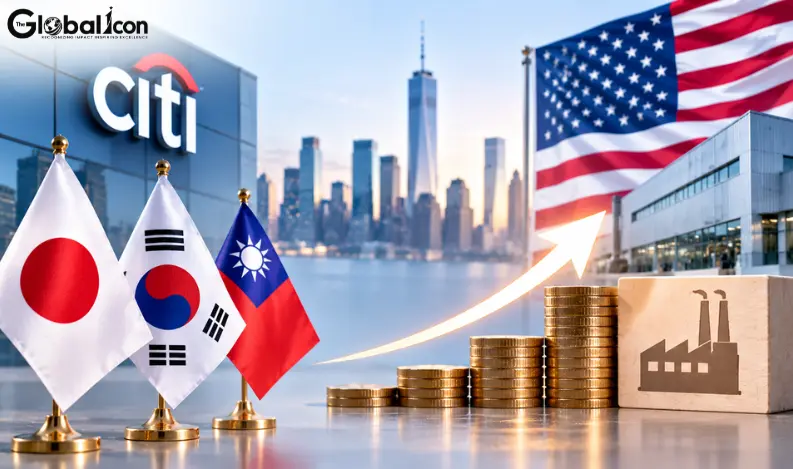
Investment by Japanese, South Korean and Taiwanese companies in the United States is expected to continue rising as businesses reshape global supply chains and expand manufacturing operations, according to a senior Citigroup executive.
Ernesto Torres Cantu, who leads Citi’s international business outside North America, told Reuters that companies from the three Asian economies still have significant capacity to invest in the US. He also pointed to double-digit growth in inbound business into North America, reflecting sustained corporate interest in the region.
Major Investment Commitments Support Growth
The investment outlook is being reinforced by large financial commitments from Asian governments and businesses. Japan has pledged $550 billion in investment in the United States, with Citi and JPMorgan Chase involved in financing projects connected to the initiative.
South Korea has also announced a $350 billion strategic investment package, with the White House recently unveiling its initial phase.
Cantu said investment in US-bound projects typically builds over several stages. Companies may initially purchase land before moving into factory construction, equipment installation and daily operations. As projects progress, the overall level of investment can continue to increase.
Supply Chain Changes Drive Corporate Decisions
Geopolitical uncertainty, trade restrictions and tariffs are encouraging multinational companies to reconsider where they manufacture products and how they move goods across international markets.
Cantu noted that while tariffs remain an important consideration, the Gulf War has also had a significant influence on business decisions, prompting companies to adjust trade routes and supply-chain strategies.
This shift is creating demand for financial services such as international payments, trade finance, transaction settlements and liquidity management. Global banks are increasingly supporting businesses as they reorganise operations across multiple markets.
Citi Sees Strong Demand for International Banking Services
Citi's latest performance reflects the growing importance of its corporate services business. The bank reported an 8% increase in overall third-quarter revenue, while revenue from its services division rose 15%.
The division provides cash management, payment processing, trade finance and liquidity solutions to corporations, financial institutions and governments.
Cantu expects cross-border business involving Asia to expand further, particularly along trade corridors connected to China and India. He said trade between the United Kingdom and India is growing significantly following tariff reductions, while the European Union's free trade agreement with India, scheduled to take effect in 2027, could create additional commercial opportunities.
He also highlighted the continued expansion of Chinese businesses into international markets, with cross-border flows from China growing by more than 20% annually over the past two years, according to Citi.
A Changing Global Investment Landscape
The continued expansion of Asian companies in the United States reflects a broader shift in global business strategy. Companies are increasingly balancing cost efficiency with supply-chain resilience, investing in multiple regions to reduce exposure to geopolitical and trade-related disruptions.
For Japan, South Korea and Taiwan, US investment is likely to remain an important part of overseas expansion, particularly in manufacturing and technology-related industries. Citi expects these investment flows to develop progressively as companies move from initial commitments to operational projects.
News Highlights:-