
Chinese technology is becoming increasingly difficult for global companies to sidestep as businesses turn to China for capabilities in artificial intelligence, electric vehicle batteries, automotive software and advanced manufacturing.
The trend marks a change in China’s role in the global economy. For years, multinational companies primarily viewed the country as a manufacturing base and a major consumer market. Increasingly, Chinese companies are also becoming technology partners for some of the world’s largest brands.
Apple Turns to Chinese AI Partners
Apple is one of the clearest examples of the shift.
The US technology giant has worked with Alibaba and Baidu as it prepares and expands artificial intelligence services for users in mainland China. Apple Intelligence was registered with Chinese regulators in July, with Alibaba’s Qwen technology integrated into Apple’s ecosystem and Baidu involved in locally tailored AI capabilities.
The arrangement highlights the importance of domestic technology providers for multinational companies operating under China’s regulatory framework.
But China’s growing technological influence is not limited to software.
Ford Looks to CATL for Battery Technology
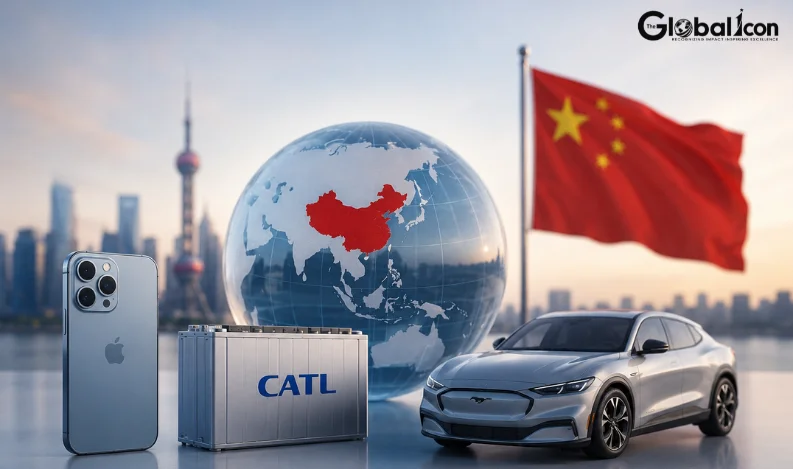
In the automotive industry, Ford has licensed lithium-iron phosphate battery technology from Chinese battery giant CATL for its Michigan battery operation.
Ford originally announced a $3.5 billion investment in the facility, designed to produce lower-cost LFP batteries in the United States using technology supplied through its agreement with CATL.
The partnership shows how deeply Chinese battery expertise has become connected to the global EV industry. Battery manufacturing requires extensive technical knowledge, established supply chains and years of development, making it difficult for automakers to rapidly replace proven technology partners.
Volkswagen Deepens Partnership With Xpeng
European automakers are also turning to Chinese companies for vehicle platforms, connectivity and software.
Volkswagen has expanded its collaboration with Xpeng, with the two companies jointly developing electric vehicles for the Chinese market. In March 2026, Volkswagen said the ID. UNYX 08 became the first production vehicle developed under its collaboration with Xpeng.
The partnership is central to Volkswagen’s “In China, for China” strategy, which seeks to shorten vehicle development cycles while using technology better suited to rapidly changing Chinese consumer expectations.
Volkswagen had already acquired a stake of around 5% in Xpeng and established cooperation covering vehicle platforms and software.
Stellantis and Leapmotor Push Cooperation Further
Stellantis is following a similar path through its relationship with Chinese EV manufacturer Leapmotor.
The automaker announced plans in 2026 to deepen the partnership, including greater localization of Leapmotor electric vehicle production in Europe. Stellantis said the expanded relationship could help manufacture competitively priced EVs closer to European customers.
Such partnerships demonstrate that Chinese automakers are no longer competing solely through exports. Their engineering, battery systems, vehicle platforms and production expertise are increasingly becoming part of broader international automotive strategies.
Technology Growth Meets Geopolitical Pressure
The growing commercial reliance on Chinese technology is developing alongside continuing geopolitical restrictions.
The United States maintains controls covering advanced computing chips, semiconductor manufacturing equipment and other technologies considered important to national security. US authorities have continued updating licensing rules and restrictions affecting exports of advanced computing products to China.
That creates a complicated environment for multinational businesses.
Companies must balance national security regulations and political pressure with commercial realities such as cost, production scale, technical performance and access to the Chinese market.
The level of cooperation is therefore likely to vary significantly by industry. Sensitive areas such as advanced semiconductors, cybersecurity and defense-related technologies are expected to remain more restricted, while sectors including batteries, electric vehicles, consumer electronics and selected AI applications could see deeper international integration.
China’s Role in Global Technology Is Changing
The bigger shift is that China is increasingly contributing not only manufacturing capacity but also technology, engineering and intellectual property to global supply chains.
Apple’s AI partnerships, Ford’s battery arrangement with CATL, Volkswagen’s work with Xpeng and Stellantis’ expanding relationship with Leapmotor all point in the same direction.
For global companies, the challenge is becoming less about whether Chinese technology will play a role in international business and more about where, how and under what regulatory conditions that technology can be used.
News Highlights:-