
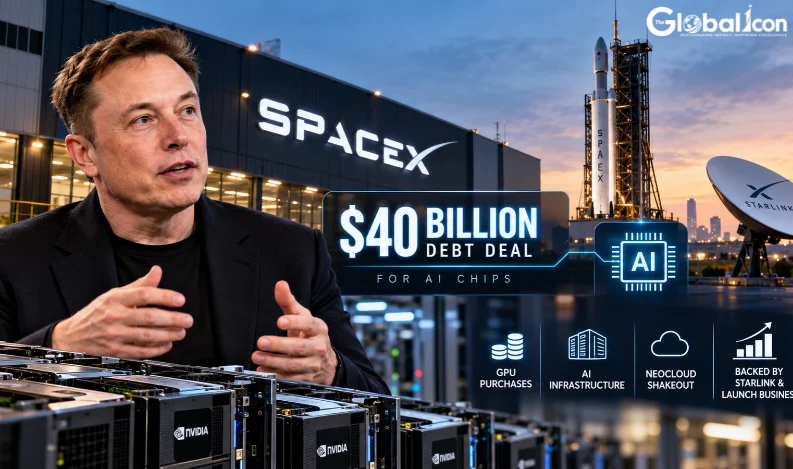
SpaceX has closed a $40 billion debt financing deal to purchase graphics processing units (GPUs) for its expanding artificial intelligence infrastructure, CEO Elon Musk announced on October 25, 2026. The financing highlights the enormous cost of building AI computing capacity as technology companies compete for access to advanced chips and data centres.
Musk attributed SpaceX’s ability to secure the funding to its investment-grade credit status and revenue from its Starlink satellite internet service and rocket launch business. He also warned that tightening credit markets could trigger widespread failures and consolidation among specialised AI cloud providers, commonly known as neoclouds.
$40 Billion Financing to Fund GPU Purchases
The financing is primarily callable debt intended to fund GPU purchases expected to arrive in the first and second quarters of 2027. Callable financing gives the borrower the ability to repay the debt early under the applicable terms.
The deal comes as SpaceX expands its AI computing operations and increases investment in infrastructure needed to train and run advanced AI models. GPUs, particularly those supplied by Nvidia, are essential to these workloads but require substantial upfront spending.
Musk said the financing would not have a major impact on the company’s current-quarter results. Details about the final pricing and structure of the transaction have not been fully disclosed publicly.
Musk Predicts Failures Among AI Cloud Providers
Alongside the financing announcement, Musk warned that more than 200 neocloud companies could face significant difficulties as lenders become more cautious about AI infrastructure investments.
Neocloud providers specialise in supplying high-performance computing capacity to AI developers and businesses. Many rely on substantial borrowing to purchase chips and build data centres, with future revenue expected to cover financing and operating costs.
Musk said credit markets had largely closed access to funding for companies without substantial revenue streams independent of AI data centres. He predicted that the sector would experience widespread consolidation, with relatively few providers surviving independently.
His comments reflect concerns about whether all AI infrastructure investments will generate sufficient returns to justify their costs. However, the outlook remains uncertain, as demand for AI computing continues to grow and financing conditions differ across companies.
Starlink and Rocket Launches Support SpaceX
SpaceX’s diversified revenue streams could give it an advantage over companies that depend almost entirely on renting out AI computing capacity. Starlink generates revenue through satellite internet subscriptions, while the company’s launch business provides services to commercial and government customers.
These established operations help distinguish SpaceX from specialised cloud providers whose financial performance is more directly tied to demand for AI computing.
The company is nevertheless committing substantial resources to AI infrastructure. SpaceX expects capital expenditure of approximately $35 billion to $40 billion in the fourth quarter of 2026, underscoring the scale of its investment plans.
AI Infrastructure Spending Faces Growing Scrutiny
The financing announcement comes amid increased scrutiny of the capital required to build AI data centres and secure advanced computing chips. Companies across the technology sector are investing heavily in infrastructure, but investors are increasingly focused on the revenue and profitability needed to justify those expenditures.
For neocloud companies, rising borrowing costs or delays in securing customers could make it harder to fund expansion. Providers with strong customer commitments, access to capital and diversified revenue may be better positioned to withstand market pressure.
Musk has also ruled out SpaceX acquiring struggling neocloud providers, saying such purchases would be pointless. His prediction of industry consolidation therefore reflects an expectation that weaker businesses may fail or lose their independence rather than become targets for SpaceX.
What the Deal Means for the AI Industry
SpaceX’s $40 billion financing demonstrates the scale of funding still available to major companies with established revenue and strong credit profiles. At the same time, Musk’s warning highlights the financial risks facing AI infrastructure businesses that depend heavily on borrowing.
As GPU demand increases and data-centre investment accelerates, the industry’s next phase may be shaped not only by technological progress but also by access to capital, customer demand and the ability to generate sustainable returns.
News Highlights:-