
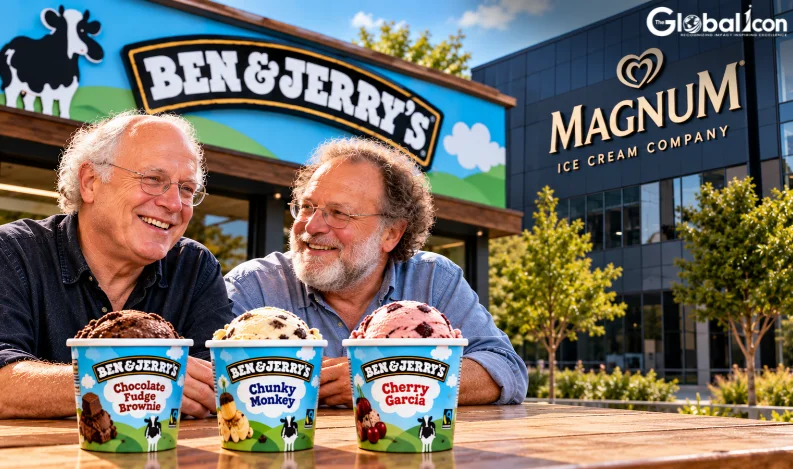
Ben Cohen and Jerry Greenfield, the co-founders of Ben & Jerry’s, are exploring a potential deal to separate the popular ice cream brand from its current owner, The Magnum Ice Cream Company, according to a Wall Street Journal report published on October 26, 2026.
The proposal would involve structuring the business around an employee stock-ownership plan, allowing workers to hold shares in the company. The discussions come amid a long-running dispute over the brand’s independence, corporate governance and commitment to social activism.
The proposed transaction remains at an exploratory stage and would require approval from Magnum, which has stated that it does not intend to sell Ben & Jerry’s.
Employee Ownership at the Centre of the Proposal
The founders have reportedly discussed the idea with Pete Stavros, a private-equity executive at KKR and founder of the organisation Expanding ESOPs, which promotes employee ownership.
Under the proposed structure, employees could receive shares in the business, giving them a direct financial stake in its performance. The arrangement could also offer tax advantages to the company, depending on how a transaction is structured.
Employee stock-ownership plans are used by some US businesses to share ownership with workers and connect employees’ financial interests with the company’s long-term performance.
For Ben & Jerry’s, such a model could provide an alternative ownership structure while potentially preserving the brand’s identity and social mission. However, the proposal would need further development, financing and agreement from the current owner before it could move forward.
Magnum Rejects the Prospect of a Sale
Magnum Ice Cream, which became an independent company after separating from Unilever, has pushed back against the idea of selling Ben & Jerry’s.
The company said the brand was not for sale and argued that it was performing well within the wider business. Magnum also warned that separating the ice cream maker could create operational inefficiencies, reduce investment in its social mission and lead to higher prices for consumers.
Ben & Jerry’s is a significant brand within Magnum’s portfolio, which also includes Magnum, Breyers, Talenti and Klondike. A separation would therefore have implications for the company’s operations, finances and brand strategy.
The disagreement highlights the challenge of negotiating a transaction involving a valuable consumer brand whose founders continue to advocate for greater independence.
Long-Running Dispute Over Social Activism
Founded in Vermont in 1978, Ben & Jerry’s built its reputation on ice cream as well as public positions on social justice, climate change and other political issues.
When Unilever acquired the company in 2000, an unusual governance arrangement preserved an independent board with authority over aspects of the brand’s social mission and related activities.
Over the years, the founders and the company’s independent board have clashed with corporate leadership over the extent of that independence. Disagreements intensified around the brand’s public positions on Israel and the Palestinian territories, as well as other social and political issues.
Jerry Greenfield left the company in 2025, citing concerns about restrictions on its ability to speak independently. Ben Cohen has continued to campaign for the brand to return to independent ownership.
The founders argue that the company’s social values are central to its identity and commercial appeal. Magnum, meanwhile, maintains that the business can continue to thrive under its ownership.
What a Separation Could Mean for the Brand
A successful deal could reshape the relationship between Ben & Jerry’s employees, its founders and its corporate owner. Employee ownership could offer workers a greater role in the company’s financial future, while a separate structure might give the brand more scope to determine its social and marketing priorities.
However, major questions remain, including how a purchase would be financed, how ownership rights would be distributed and how the brand’s independent governance would be protected.
No agreement has been announced, and Magnum’s opposition represents a substantial obstacle. The proposal may also require negotiations over the brand’s valuation, business operations and future investment.
For now, the discussions underscore a broader business question: whether a mission-driven consumer brand can preserve its founding principles while operating within a large corporate group. Any progress will depend on whether the founders can develop a commercially viable proposal that the current owner is willing to consider.
News Highlights:-